G7#5
A dominant with the fifth pushed up — and harder to resist.
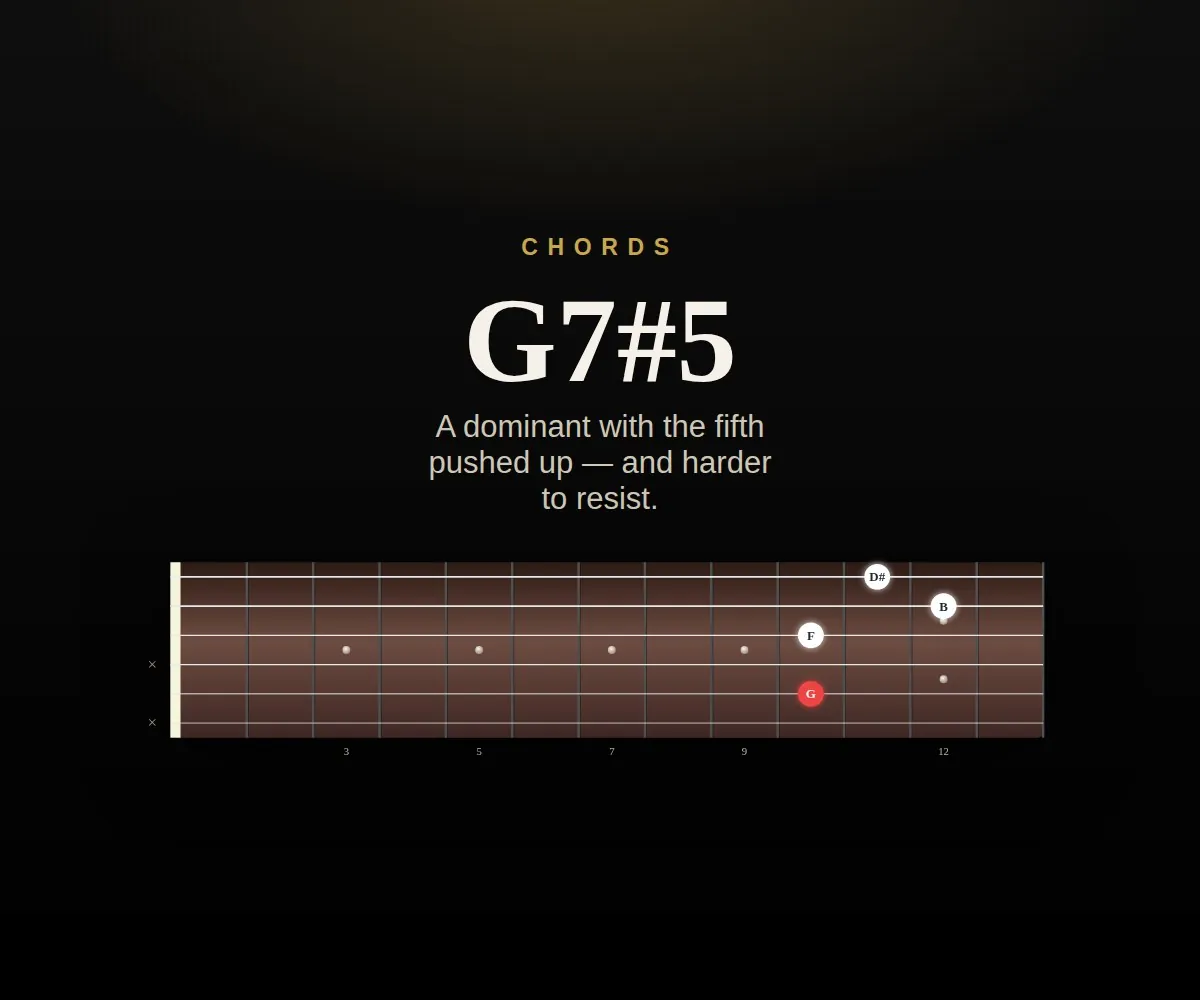
G7#5 raises the 5th of a dominant 7th chord by a half-step. That one change turns a chord that wants to resolve into one that almost has to.
 Play G7#5 on your phoneDownload free
The 5th raised
G7#5 is G B D# F. A plain G7 has D as its 5th; here it is raised to D#. The chord now contains an augmented triad (G B D#) with a ♭7 on top.
- The #5 (D#) replaces the natural 5.
- It is an augmented triad plus a ♭7.
- Also written G7+5 or G+7.
Two notes leaning at once
In a G7 going to C, the B already pulls up to C. Add the D# and it pulls up to E — the 3rd of C. Now two voices are leaning into the target chord instead of one.
- B → C and D# → E, both by half-step.
- Two leading tones instead of one.
- That is why it resolves more strongly than a plain G7.
V to I, and in blues
Use it as the V chord: G7#5 → C. It is also a staple ending in blues and soul, where the last dominant before the turnaround gets raised for one bar to push into the resolution.
- Substitute it for G7 in any V–I.
- Standard on the last V chord of a blues turnaround.
- G altered or the whole-tone scale both fit over it.
Raise the 5th of a dominant chord and you create a second leading tone. Two notes leaning home instead of one.
 Prefer paper? All 2,592 chords in one bookThe Guitar Chord & Scale Encyclopedia · paperback and KindleSee the book →
MoreThanModes.com · Visual. Clear. Musical.