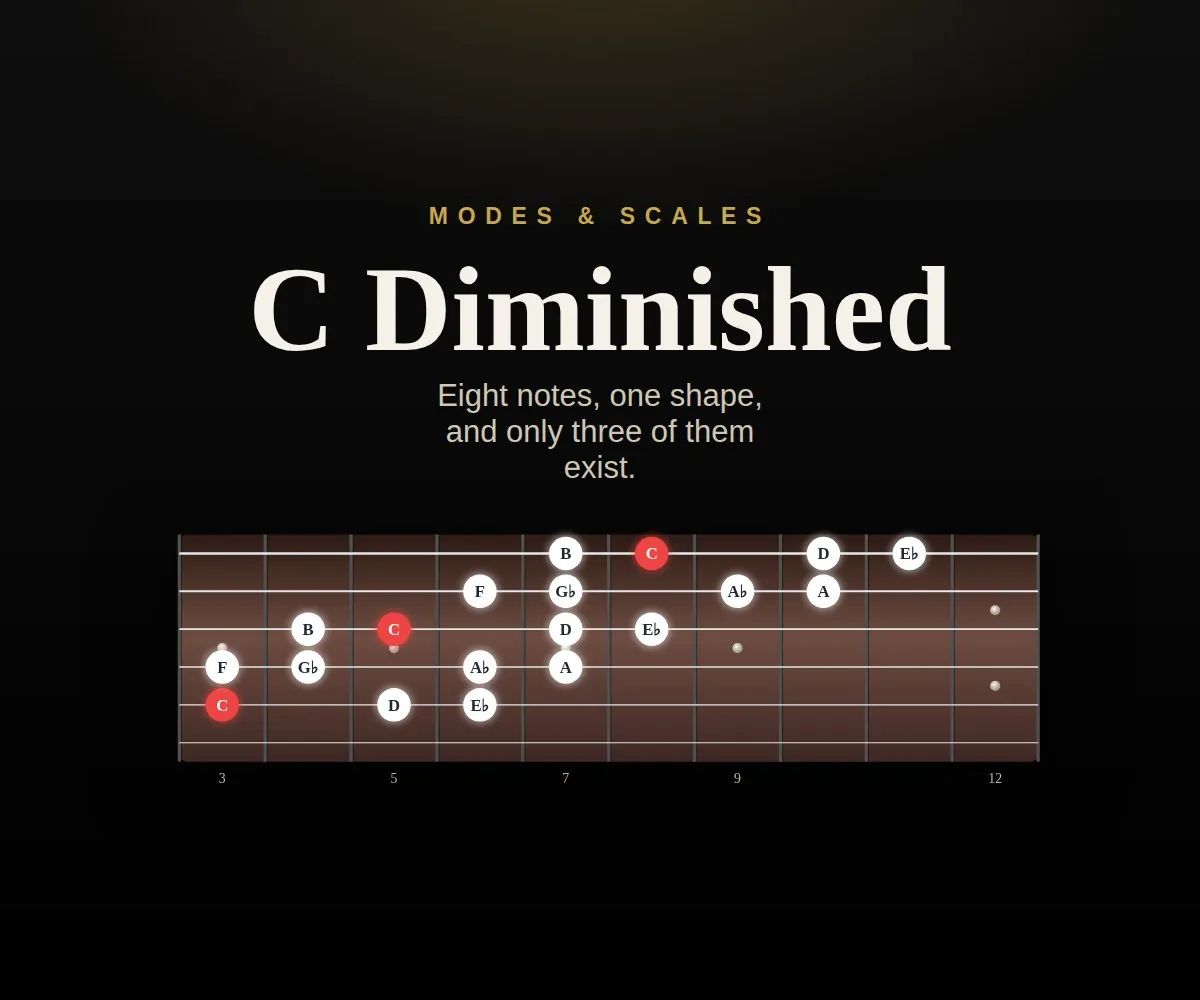
C Diminished
Eight notes, one shape, and only three of them exist.
The diminished scale alternates whole steps and half steps, forever. Because the pattern repeats every three frets, one shape covers the whole neck — and there are only three different diminished scales in all of music.
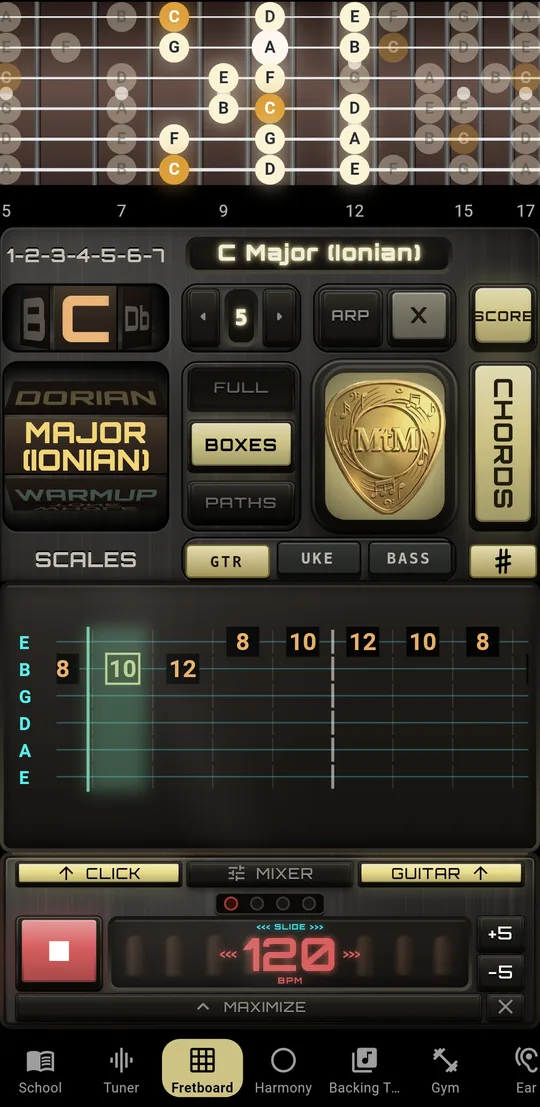 Play C Diminished on your phoneDownload free
Whole, half, whole, half
C diminished (whole-half) is C D E♭ F G♭ A♭ A B. Eight notes, built by alternating a whole step and a half step. There is no key it belongs to — it is a pattern, not a scale derived from a key.
- Strict alternation: whole step, half step, repeat.
- Eight notes instead of seven.
- It is symmetrical — no note is more 'home' than another.
It repeats every minor third
Because the pattern is symmetrical, C, E♭, G♭ and A diminished are the same eight notes. That means there are only three diminished scales in existence, and one fingering shifted up three frets covers everything.
- C, E♭, G♭ and A diminished are identical.
- Only three distinct diminished scales exist.
- Learn one shape and slide it in minor thirds.
Over a diminished chord
This version — whole step first — goes over a diminished 7th chord. (Start with the half step instead and you get the half-whole scale, which is the one for dominant 7♭9 chords. They are not interchangeable.)
- Whole-half goes over dim7 chords.
- Half-whole goes over 7♭9 dominants — a different scale.
- Passing dim7 chords between diatonic chords are the usual place to find it.
Symmetry is the whole story: three scales, one shape, and a pattern that never picks a home note.
 Prefer paper? All 408 scale charts in one bookThe Guitar Chord & Scale Encyclopedia · paperback and KindleSee the book →
MoreThanModes.com · Visual. Clear. Musical.