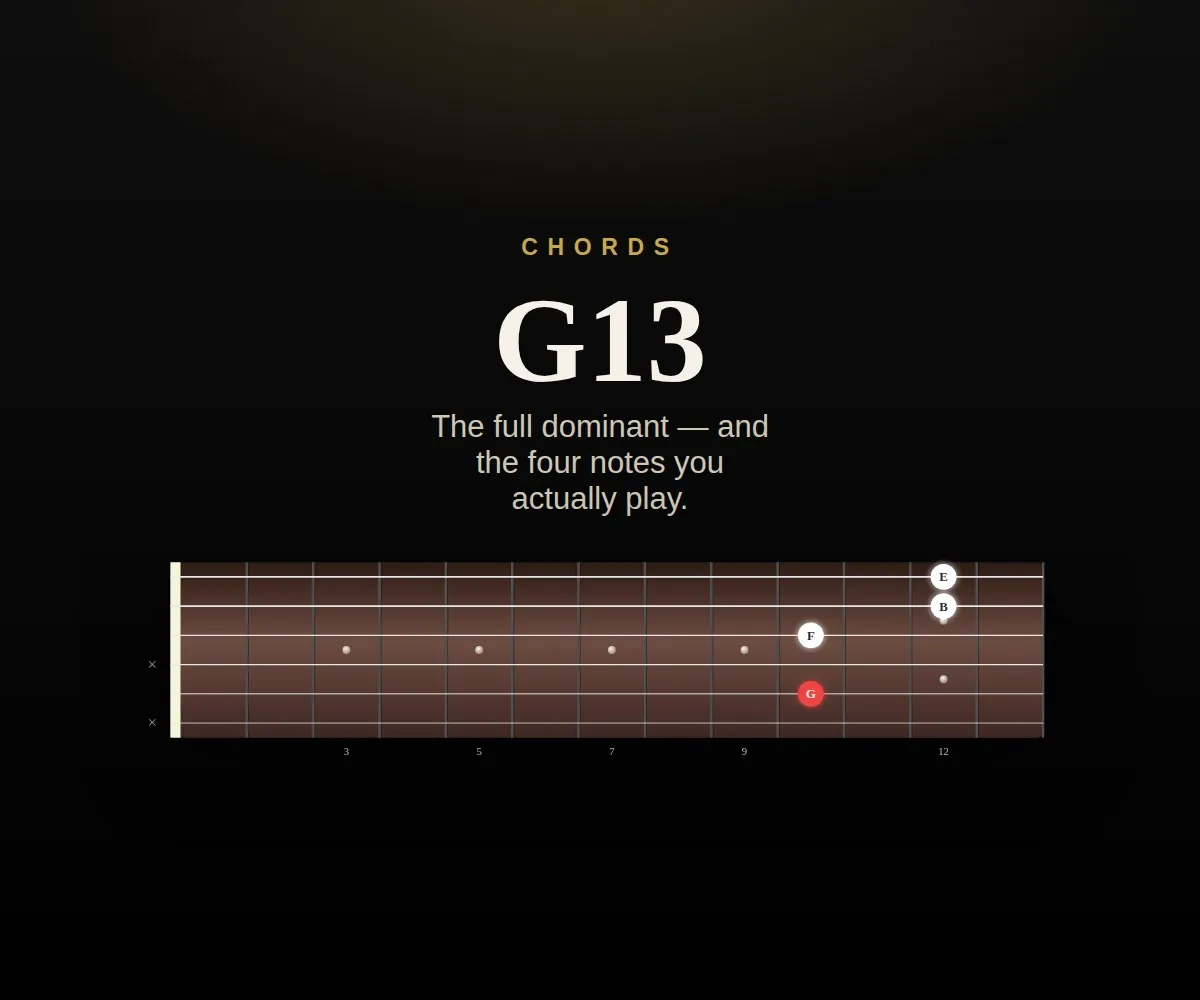
G13
The full dominant — and the four notes you actually play.
G13 is a dominant chord with everything stacked on: 7th, 9th, 11th and 13th. On paper it is seven notes. On a guitar it is four, and knowing which four is the entire skill.
 Play G13 on your phoneDownload free
Seven notes on six strings
In full, G13 is G B D F A C E — the whole scale stacked in thirds. You have six strings and five fingers, so the chord as written is not playable and was never meant to be.
- It is a dominant 7th with the 9, 11 and 13 added.
- The 13 (E) is the 6th, an octave up.
- Written in full it is seven notes — a whole scale.
What to keep
Keep the 3rd (B), the ♭7 (F) and the 13th (E). The 3rd and ♭7 define the dominant; the 13 is the colour you are naming. Drop the 5th, drop the 11th (it clashes with the 3rd), and let the bass have the root.
- Keep 3, ♭7 and 13 — that is a real G13.
- Drop the 5th and the 11th first.
- The 11th is the one note that actively fights the chord.
In a V–I
Use it as the V chord where a plain 7th sounds too blunt: Dm7 – G13 – Cmaj7. It is also the standard funk dominant, where the 13 voicing on the middle strings is the whole rhythm part.
- Substitute it for any G7 in a ii–V–I.
- It is the core funk rhythm-guitar voicing.
- G Mixolydian fits it, avoiding the 11th.
An extended chord is a name for a sound, not an instruction to play every note. Keep the 3rd, the ♭7 and the extension, and drop the rest.
 Prefer paper? All 2,592 chords in one bookThe Guitar Chord & Scale Encyclopedia · paperback and KindleSee the book →
MoreThanModes.com · Visual. Clear. Musical.