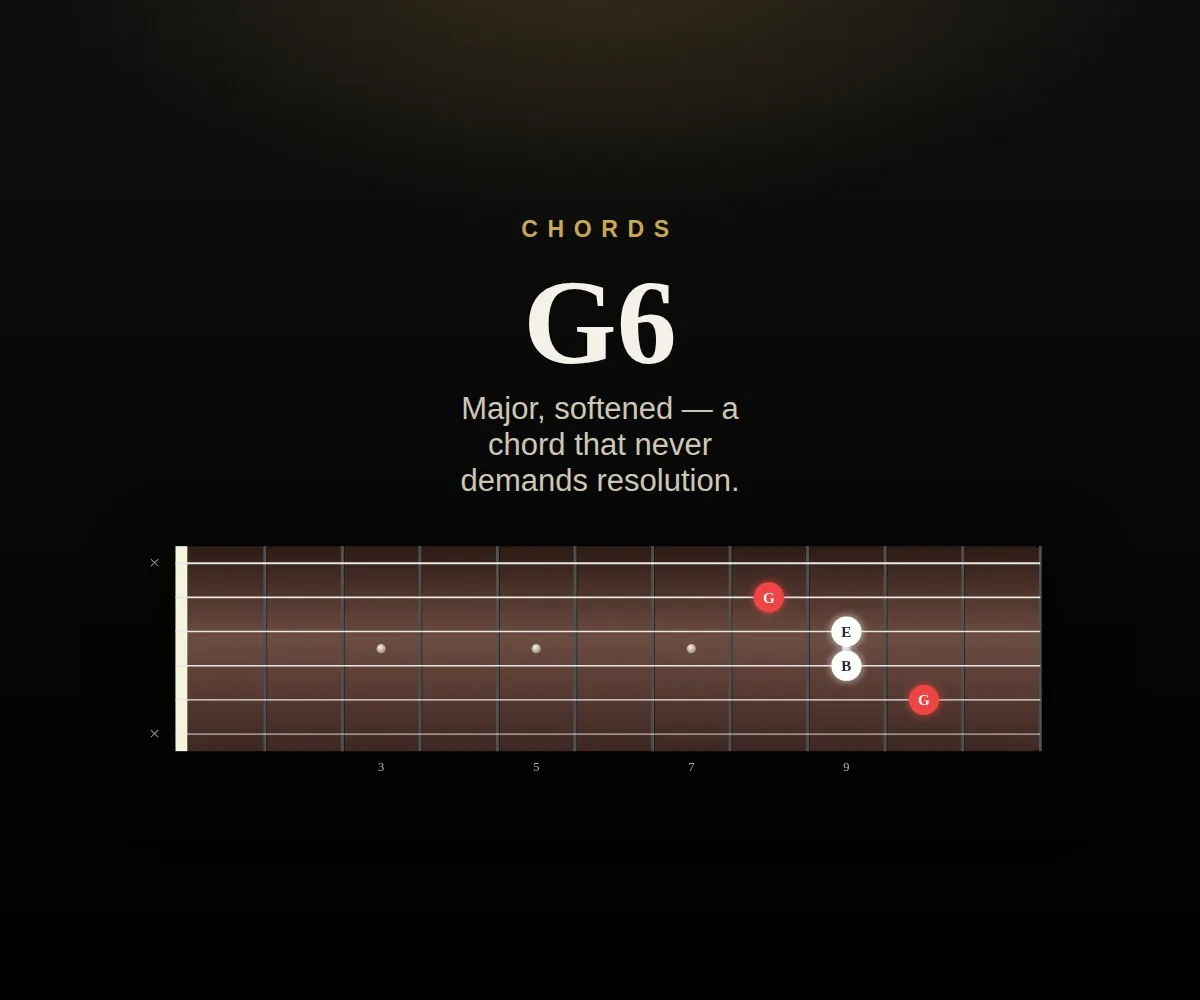
G6
Major, softened — a chord that never demands resolution.
G6 is a major triad with a 6th added instead of a 7th. It sounds finished in a way maj7 does not — bright, relaxed, and completely at rest.
 Play G6 on your phoneDownload free
Major triad plus a 6th
G6 is G B D E — a G major triad with E on top. The 6th is a consonant note, so nothing about it wants to move anywhere.
- It is G major with the 6th (E) added.
- No 7th, so no tension and no pull.
- It is a fuller major chord that stays completely at rest.
The same notes as Em7
G B D E is also E G B D — an Em7. The two chords are identical; only the bass note decides. That is one of the most useful substitutions on the instrument.
- G6 and Em7 contain the same four notes.
- Whichever note the bass plays becomes the root.
- Use it to move between a major and its relative minor without changing grip.
Endings and old records
Use it as the final chord of a song where a plain major sounds too plain and a maj7 too jazzy. It is the classic ending of fifties pop and western swing, and it works anywhere a G is written.
- Substitute it for any plain G major chord.
- It is the standard vintage-pop final chord.
- Also works as the I in a swing or country turnaround.
A 6th adds colour without adding tension — the reason G6 can end a song where a maj7 would leave it hanging.
 Prefer paper? All 2,592 chords in one bookThe Guitar Chord & Scale Encyclopedia · paperback and KindleSee the book →
MoreThanModes.com · Visual. Clear. Musical.