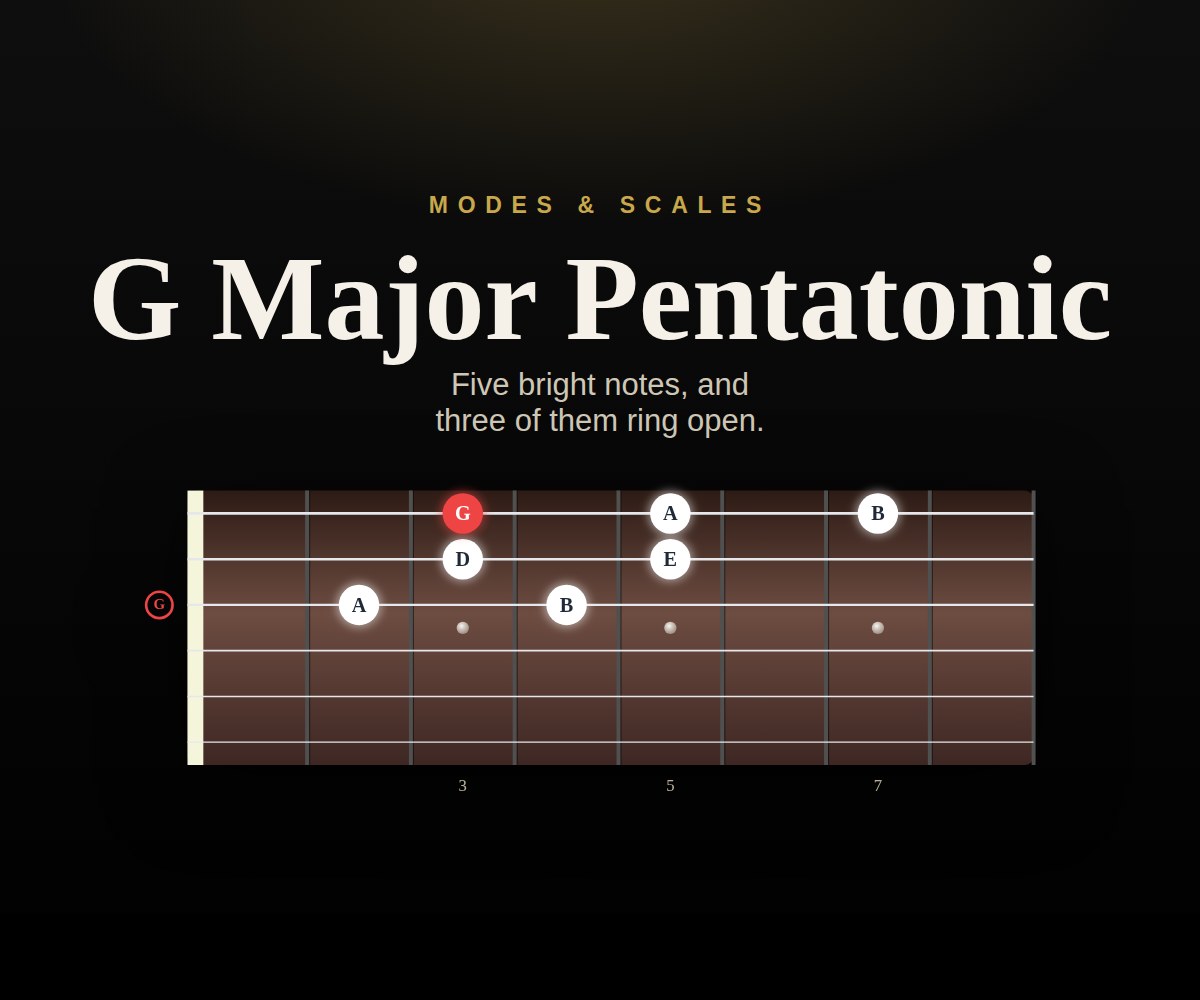
G Major Pentatonic
Five bright notes, and three of them ring open.
G major pentatonic is G, A, B, D and E. In G the scale meets the open strings in the most useful way possible: G, B, D and E are all open strings and all belong to the scale.
Major, with the two notes that argue removed
Take G major and drop the 4th (C) and the 7th (F#). What is left is G A B D E — formula 1 2 3 5 6. Those two removed notes are the ones that pull towards a resolution; without them the scale simply sits there, bright and stable.
- G A B D E — the formula is 1 2 3 5 6.
- The major 3 (B) is what keeps it major.
- No half-steps at all, so nothing can clash.
The key the instrument was built for
Four of the six open strings are in G major pentatonic. That is why open-position G sounds so full, and why country, folk and bluegrass live here: you can play a phrase high on the neck and let an open string ring under it.
- Open G, B, D and E strings all belong to the scale.
- Box 1 at the 3rd fret, root on the low E string.
- The relative minor is E minor pentatonic — the same five notes.
Where G major pentatonic lives
Over G, C and D — the three chords half of folk and country is made of — this one scale covers everything. It is also the sweet option over a G blues, where it trades the grit of the minor pentatonic for something singable.
- Fits G, Gmaj7, and a G–C–D progression whole.
- The core scale of country, folk and bluegrass lead playing.
- Mix it with G minor pentatonic for the classic blues-rock sound.
G major pentatonic is the brightest five notes on a guitar, and the only key where four open strings play along.
MoreThanModes.com · Visual. Clear. Musical.