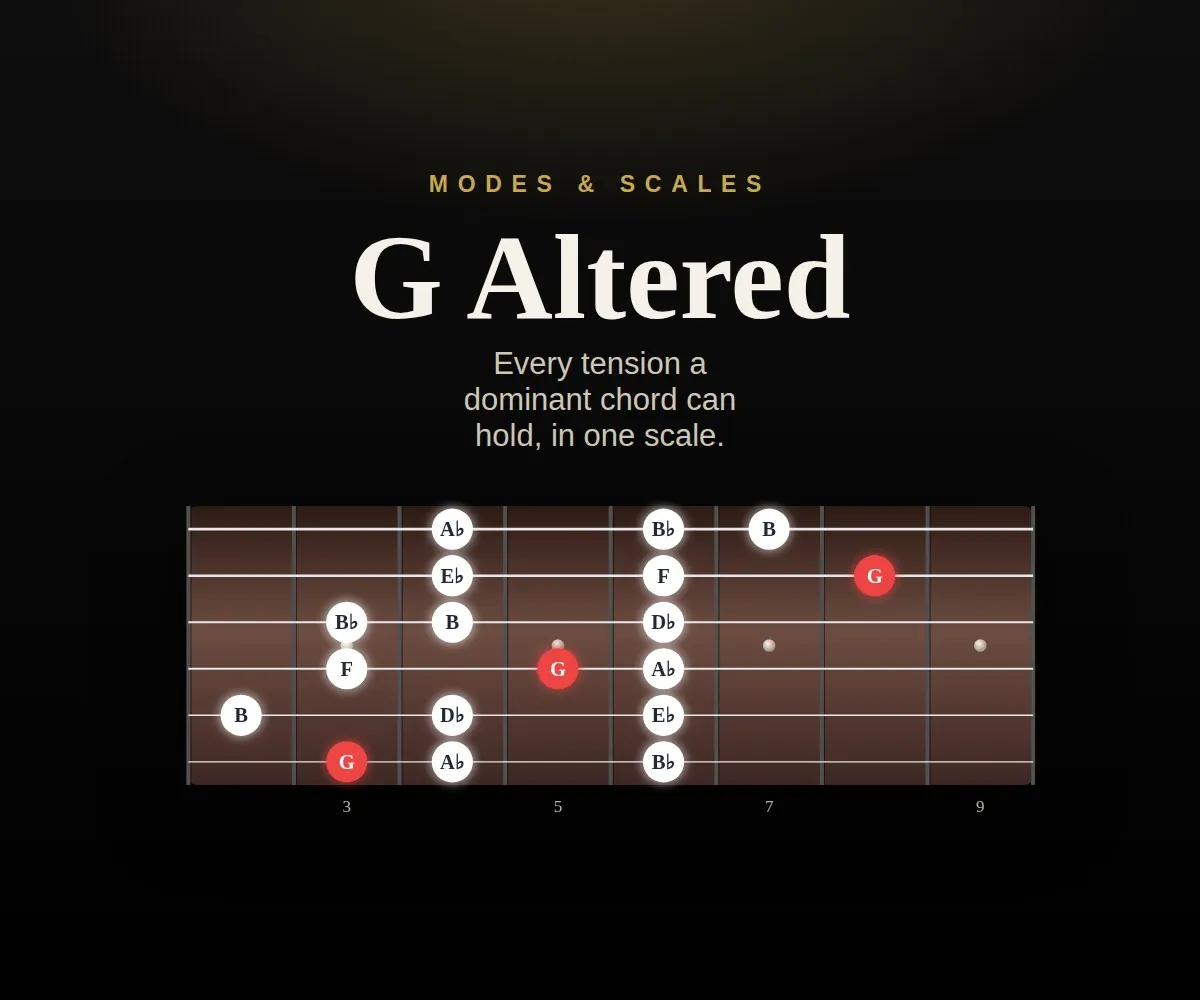
G Altered
Every tension a dominant chord can hold, in one scale.
The altered scale contains the root, the 3rd and the ♭7 of a dominant chord — and then every possible alteration of the 5th and 9th. It is the sound of maximum tension right before a resolution.
 Play G Altered on your phoneDownload free
The chord tones, plus every tension
G altered is G A♭ B♭ B D♭ E♭ F. Inside it are the 3rd (B) and the ♭7 (F) that make it dominant, plus the ♭9 (A♭), #9 (B♭), ♭5 (D♭) and #5 (E♭) — all four alterations at once.
- It keeps the 3 and ♭7 — it is still a dominant scale.
- ♭9, #9, ♭5 and #5 are all present.
- There is no natural 5 and no natural 9 anywhere in it.
It is melodic minor from a half-step up
G altered is A♭ melodic minor played from G. If you already know melodic minor shapes, you already know this scale — play the melodic minor a half-step above the dominant's root.
- G altered = A♭ melodic minor starting on G.
- Move any melodic minor shape up one fret from the chord root.
- One shape family covers every altered dominant.
Only where it resolves
It goes over an altered dominant — G7alt — and only for as long as that chord lasts. Over Dm7 – G7alt – Cmaj7, play it for one bar and land on a chord tone of C. Held longer, it stops sounding like tension and starts sounding lost.
- Play it over G7alt, G7#9, G7♭9 or G7#5.
- Resolve into the next chord — that is the whole point.
- One bar of it is usually enough.
The altered scale is not a colour to sit in. It is the maximum tension you can build in one bar before letting it go.
 Prefer paper? All 408 scale charts in one bookThe Guitar Chord & Scale Encyclopedia · paperback and KindleSee the book →
MoreThanModes.com · Visual. Clear. Musical.