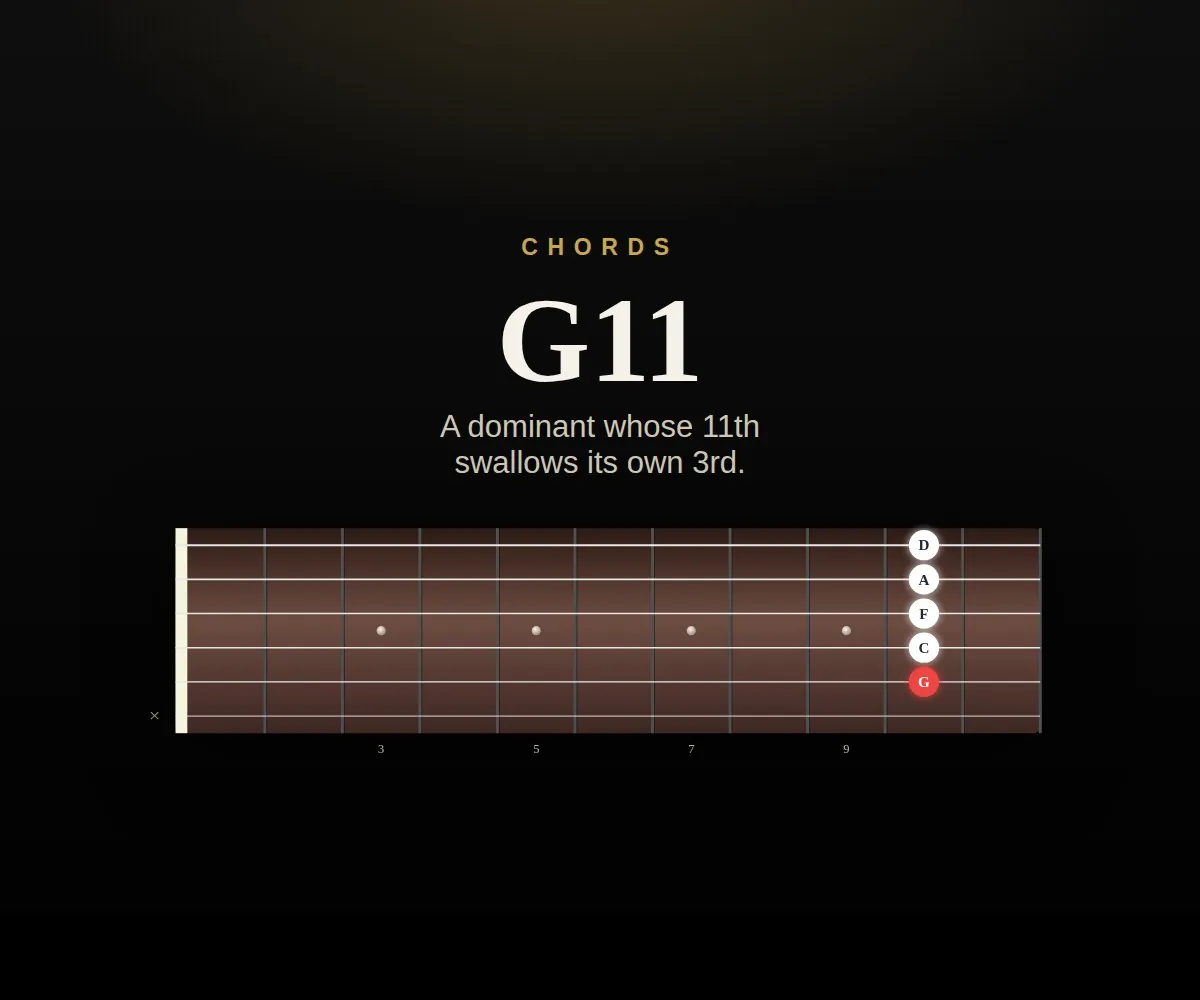
G11
A dominant whose 11th swallows its own 3rd.
G11 is a dominant 7th with the 9th and 11th stacked on top. The problem is that the 11th sits a half-step above the 3rd — so in practice the 3rd is left out, and the chord becomes something else entirely.
 Play G11 on your phoneDownload free
Six notes, one conflict
On paper G11 is G B D F A C. The 11th (C) is a half-step above the 3rd (B), and that interval inside a chord sounds like a mistake rather than a colour.
- The 11 (C) and the 3 (B) are a half-step apart.
- That clash is the defining problem of this chord.
- It does not occur in m11, where the 3rd is flat.
Drop the 3rd and see what is left
Take the B out and you have G F A C — which is an F major triad over a G bass. That is why an '11' chord on a chart is almost always played as a slash chord: F/G.
- Remove the 3rd and G11 becomes F/G.
- Written as C/G or Dm7/G in different charts — same idea.
- This is why 11 chords sound suspended, not dominant.
As a suspension before the V
Use it exactly like a 7sus4: hold it, then move to a real G7 or straight to C. It is the standard gospel and soul approach chord, where the F/G hangs for a bar before the resolution lands.
- Play it as F/G — a major triad over the V bass.
- Move it to G7 or resolve straight to C.
- G Mixolydian fits, with the 3rd treated as a passing note.
An 11 chord is a dominant that gave up its third. Once you play it as F/G, everything about it makes sense.
 Prefer paper? All 2,592 chords in one bookThe Guitar Chord & Scale Encyclopedia · paperback and KindleSee the book →
MoreThanModes.com · Visual. Clear. Musical.