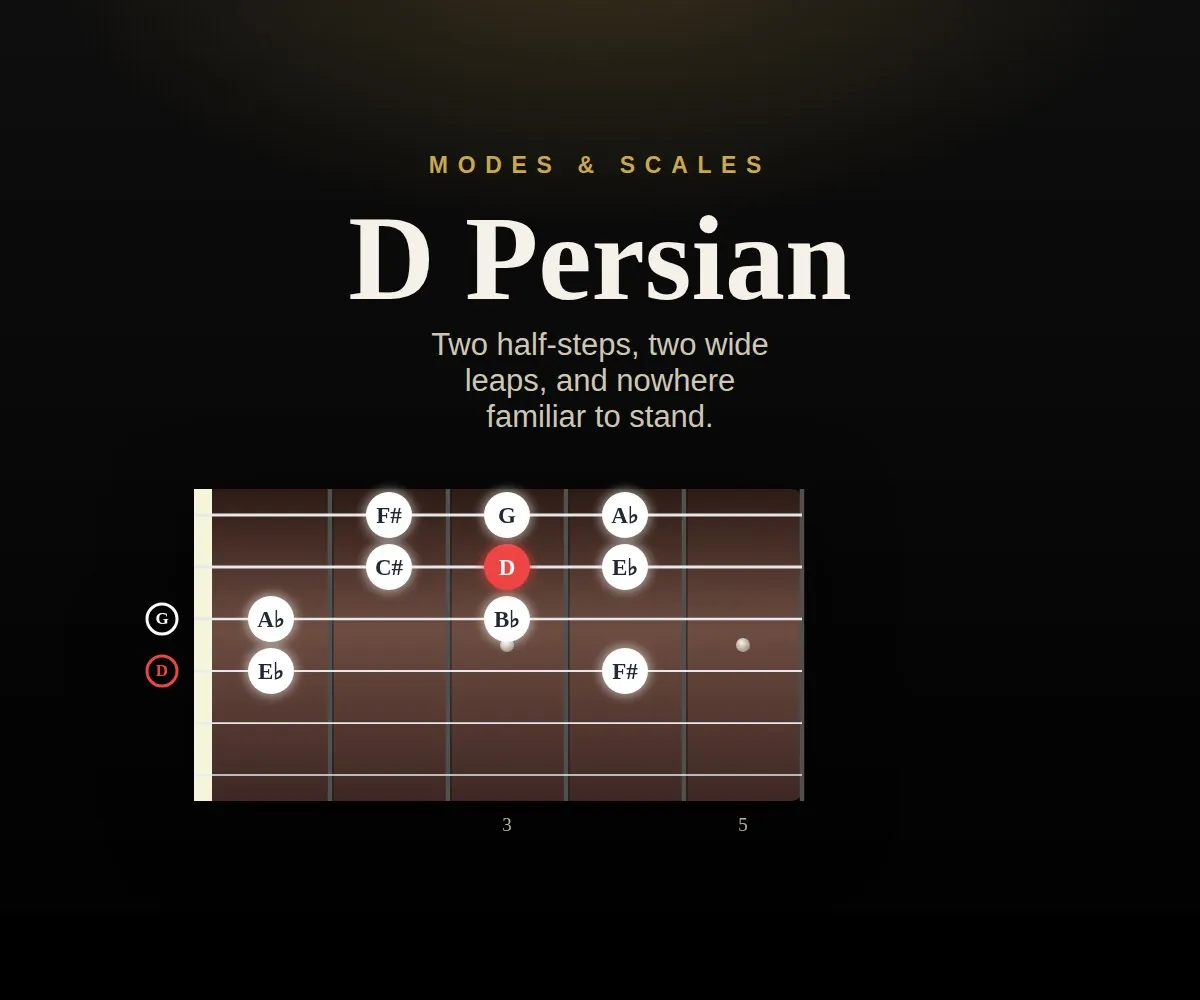
D Persian
Two half-steps, two wide leaps, and nowhere familiar to stand.
The Persian scale is the most distant-sounding scale in the app. It is worth learning not because you will use it every day, but because it shows what happens when a scale is built out of leaps rather than steps.
 Play D Persian on your phoneDownload free
A scale of extremes
D Persian is D E♭ F# G A♭ B♭ C#. It has a ♭2, a major 3, a ♭5, a ♭6 and a natural 7. Half of its steps are half-steps and two of them are three-fret jumps.
- The ♭2 (E♭) and major 3 (F#) sit three frets apart.
- The ♭5 (A♭) is what removes any sense of a normal key.
- Two augmented seconds, like Hungarian minor.
Why it feels unmoored
There is no perfect 5th above the root, so the interval that normally anchors a key is missing. Combined with the major 3rd and the natural 7th, the ear keeps looking for a home chord that the scale never provides.
- No perfect 5th means no stable tonic chord.
- Major 3 and natural 7 suggest major; the ♭5 and ♭6 deny it.
- That contradiction is the whole effect.
As a colour, over a drone
Play it over a static D pedal — a drone rather than a chord progression. It works as a melodic device: a run, a fill, an intro. Trying to harmonise it in the usual way fights the scale rather than using it.
- A single droning root is the right context.
- Use it melodically, not as the basis for chord changes.
- Cinematic and metal writing use it exactly this way.
Take away the perfect 5th and a scale loses its anchor. Persian is what that sounds like — and why it never settles.
 Prefer paper? All 408 scale charts in one bookThe Guitar Chord & Scale Encyclopedia · paperback and KindleSee the book →
MoreThanModes.com · Visual. Clear. Musical.