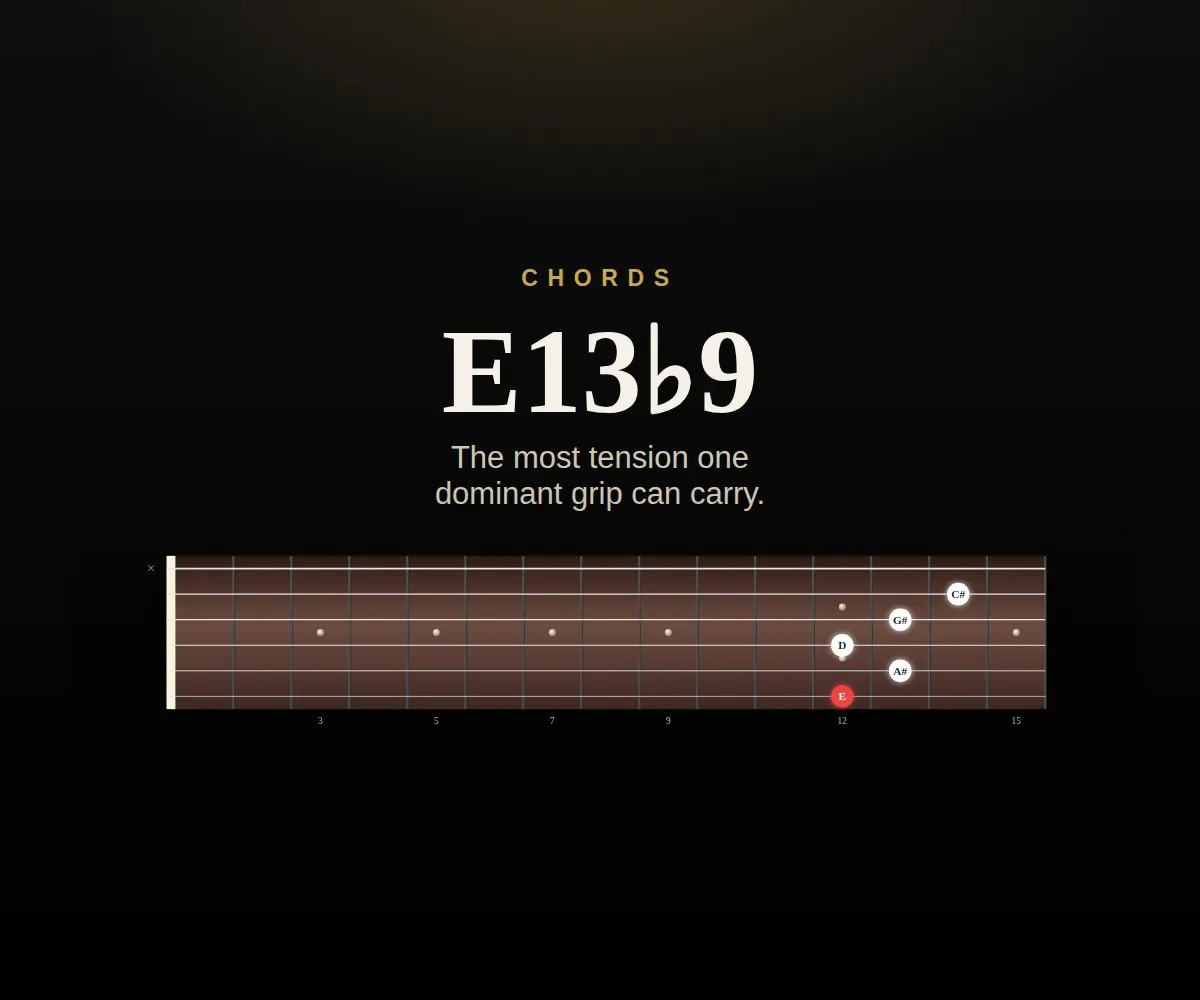
E13♭9
The most tension one dominant grip can carry.
E13♭9 combines a bright 13th with a harsh flat 9th over the same dominant chord. It sounds like it should not work, and it is one of the most-used voicings in jazz and soul guitar.
 Play E13♭9 on your phoneDownload free
One tension up, one down
E13♭9 is E G# B D F C#. The ♭9 (F) is a half-step above the root — pure friction. The 13 (C#) is consonant and bright. Both sit on the same dominant chord at once.
- The ♭9 (F) grinds; the 13 (C#) sings.
- Underneath, it is still a plain E7.
- It is one of the standard 'altered dominant' voicings.
The diminished scale explains it
Both the ♭9 and the natural 13 belong to the half-whole diminished scale built on E. They are not two unrelated choices — they come from the same source, which is why the chord holds together.
- ♭9 and 13 coexist in the half-whole diminished scale.
- That scale is the one to play over this chord.
- The combination is deliberate, not a clash.
Resolving to minor
Use it as the V of a minor key — E13♭9 → Am. It is also the funk dominant of choice: one grip on the middle strings, held over a groove, carries the entire harmony of the section.
- E13♭9 → Am is the minor resolution.
- A staple funk and soul comping voicing.
- Half-whole diminished or E altered both fit.
A flat 9 and a natural 13 in one chord are not a contradiction — they are two notes of the same diminished scale.
 Prefer paper? All 2,592 chords in one bookThe Guitar Chord & Scale Encyclopedia · paperback and KindleSee the book →
MoreThanModes.com · Visual. Clear. Musical.