E Natural Minor
The most guitar-shaped minor there is.
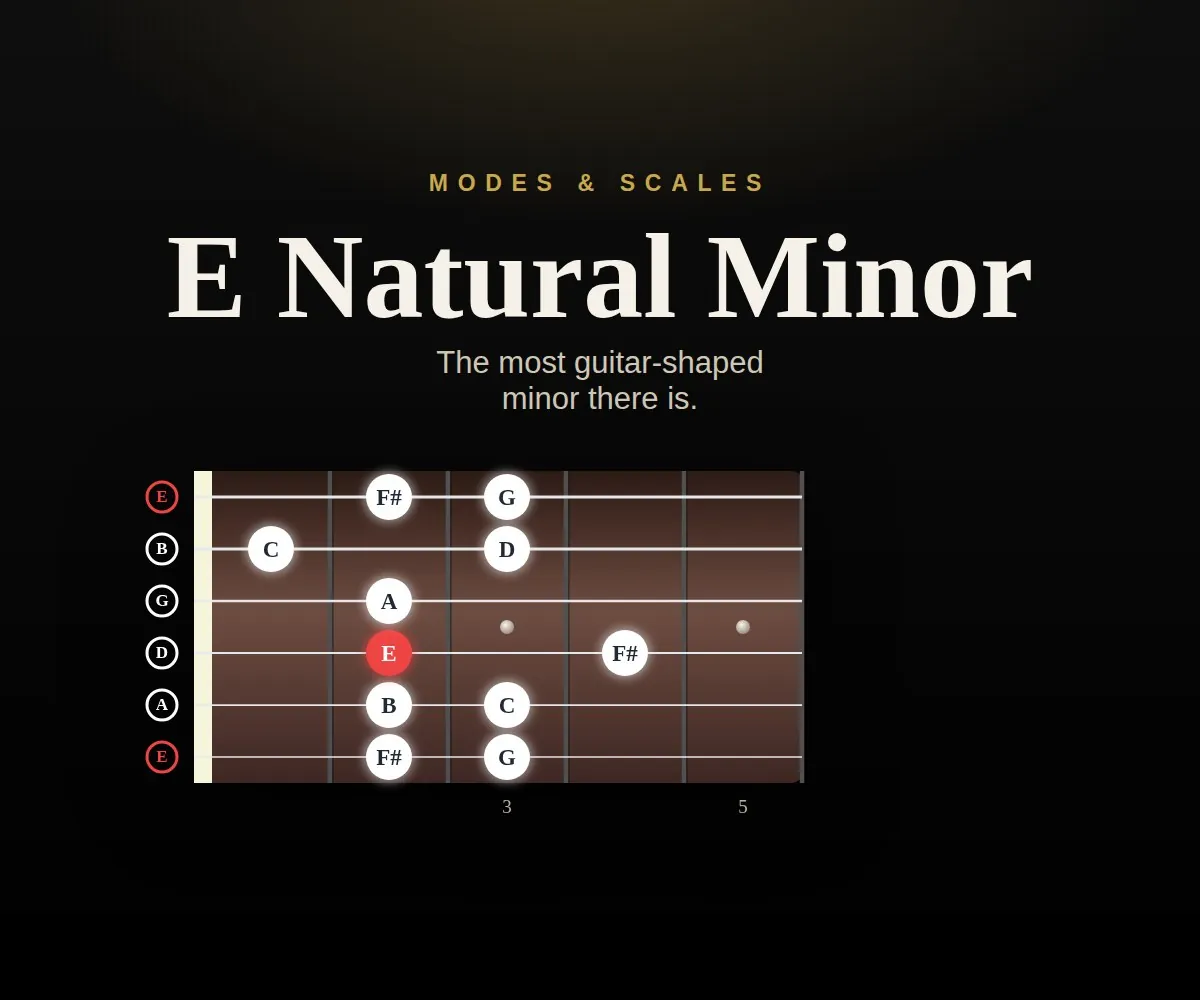
E natural minor is the relative minor of G major — same seven notes, different home. On a guitar it is the friendliest minor key that exists, because the instrument is tuned into it.
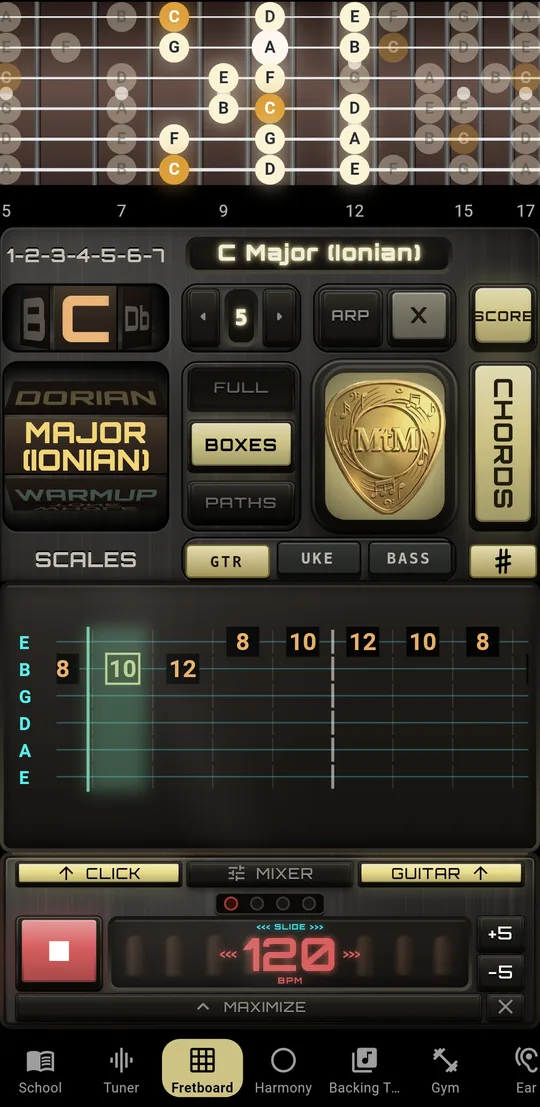 Play E Natural Minor on your phoneDownload free
The pure minor sound, rooted on E
E Aeolian is E F# G A B C D. The ♭3 (G) makes it minor; the ♭6 (C) and ♭7 (D) keep it fully dark, with no raised leading tone pulling it toward classical minor.
- The ♭3 (G) is what makes it minor.
- The ♭7 (D) is a whole step below the root — it does not pull, it settles.
- Same notes as G major, but E is home.
Why this key feels different
Both E strings, the B, the G, the D and the A are all notes of E minor — the guitar's open tuning is almost this scale. Open strings ring against fretted notes without clashing, which is why so much rock lives here.
- Every open string except none belongs to the scale.
- Open strings can ring through a riff as pedal tones.
- The first position needs no barre at all.
The progressions it produces
Harmonised, E minor gives Em F#dim G Am Bm C D. The everyday minor progression is i–♭VI–♭VII (Em–C–D), and it resolves without ever needing a raised 7th.
- Em–C–D (i–♭VI–♭VII) is the natural-minor cadence.
- Em–Am–D–G walks the whole key in four chords.
- If the song has a B major chord, it has left this scale — see harmonic minor.
All chords in the key of E minor — hear them on the circle →
E minor is where the guitar's own tuning already lives. Learn it here and the shapes transfer everywhere else.
 Prefer paper? All 408 scale charts in one bookThe Guitar Chord & Scale Encyclopedia · paperback and KindleSee the book →
MoreThanModes.com · Visual. Clear. Musical.