E Harmonic Minor
Minor with a raised 7th — and the gap that comes with it.
Harmonic minor exists to solve one problem: natural minor has no leading tone, so its V chord is minor and does not resolve. Raise the 7th and the problem disappears — but a very unusual interval appears in its place.
 Play E Harmonic Minor on your phoneDownload free
One note raised, for a reason
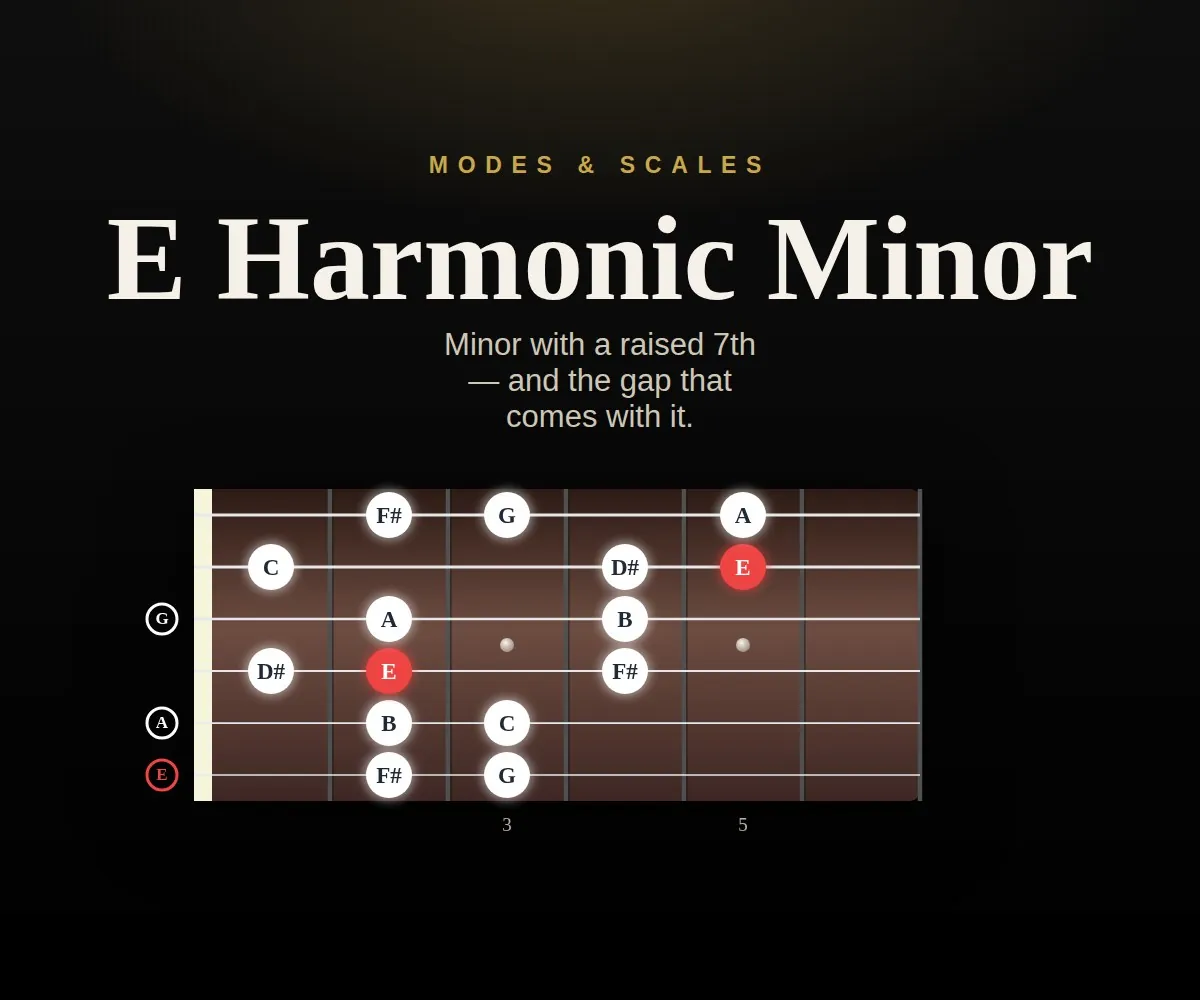
E harmonic minor is E F# G A B C D#. It is E natural minor with the D raised to D#. That D# is a half-step below E, so it finally pulls home the way a major key's 7th does.
- The raised 7 (D#) is the leading tone.
- Everything else is identical to E natural minor.
- It exists to make the V chord dominant.
An augmented second
Raising the 7th leaves a three-fret gap between the ♭6 (C) and the 7 (D#). That interval — an augmented 2nd — is what gives harmonic minor its Middle-Eastern, neoclassical edge. It is a by-product, not the goal.
- C to D# is three frets: an augmented 2nd.
- That gap is the sound people recognise as 'exotic'.
- It is the only place in the scale where the steps are uneven.
Over the V chord
The point is the B7 chord. In E natural minor the fifth chord is Bm and it goes nowhere; harmonic minor's D# turns it into B7, which drives hard into Em. Use the scale over that chord specifically.
- Play it over the V7 (B7) in an E minor progression.
- Em–Am–B7–Em is the classic harmonic-minor cadence.
- Over the Em itself, natural minor usually sits better.
Harmonic minor is not an exotic scale someone invented. It is natural minor with one note fixed — and the exotic sound is the side effect.
 Prefer paper? All 408 scale charts in one bookThe Guitar Chord & Scale Encyclopedia · paperback and KindleSee the book →
MoreThanModes.com · Visual. Clear. Musical.