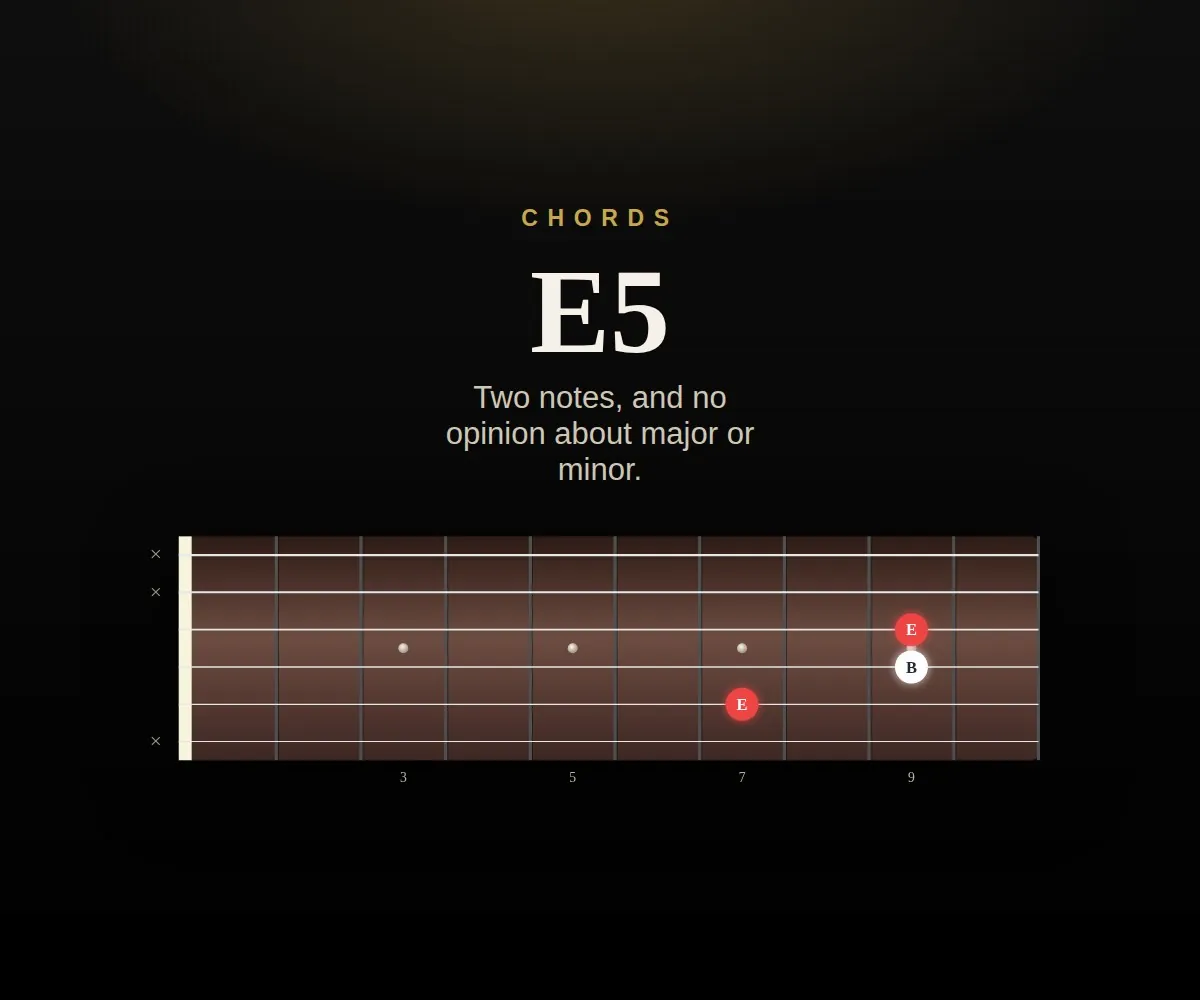
E5
Two notes, and no opinion about major or minor.
The power chord is the smallest chord that still works: root and fifth, nothing else. Leaving out the third is not laziness — it is what lets it sit under distortion without turning to mud.
 Play E5 on your phoneDownload free
A chord with no third
E5 is E B — the root and the perfect 5th. The 3rd is what tells your ear major or minor, and a power chord simply does not have one. That is why the same shape works under a major riff and a minor one.
- No 3rd means neither major nor minor.
- Root + 5th is the most stable interval after the octave.
- It borrows its mood from whatever is played around it.
Distortion and the physics of it
Heavy distortion adds sum and difference tones between every pair of notes. Two notes produce a handful of extras; a full triad produces a mess. Dropping the 3rd is what keeps a high-gain chord clear.
- Fewer notes = fewer intermodulation products = a cleaner distorted sound.
- A major 3rd under high gain beats badly against the harmonics.
- This is why rock and metal are built on two-note chords.
Moving it around
The E5 shape on the low strings is fully moveable — slide it up two frets for F#5, up five for A5. Because there is no 3rd, you never have to think about whether the key wants a major or a minor version.
- One shape covers all twelve roots — just slide it.
- Add the octave root on top for a fuller three-note version.
- Palm-mute the low root for the classic chug.
Take the third out of a chord and you take out its opinion. That is exactly why the power chord survives distortion when nothing else does.
 Prefer paper? All 2,592 chords in one bookThe Guitar Chord & Scale Encyclopedia · paperback and KindleSee the book →
MoreThanModes.com · Visual. Clear. Musical.