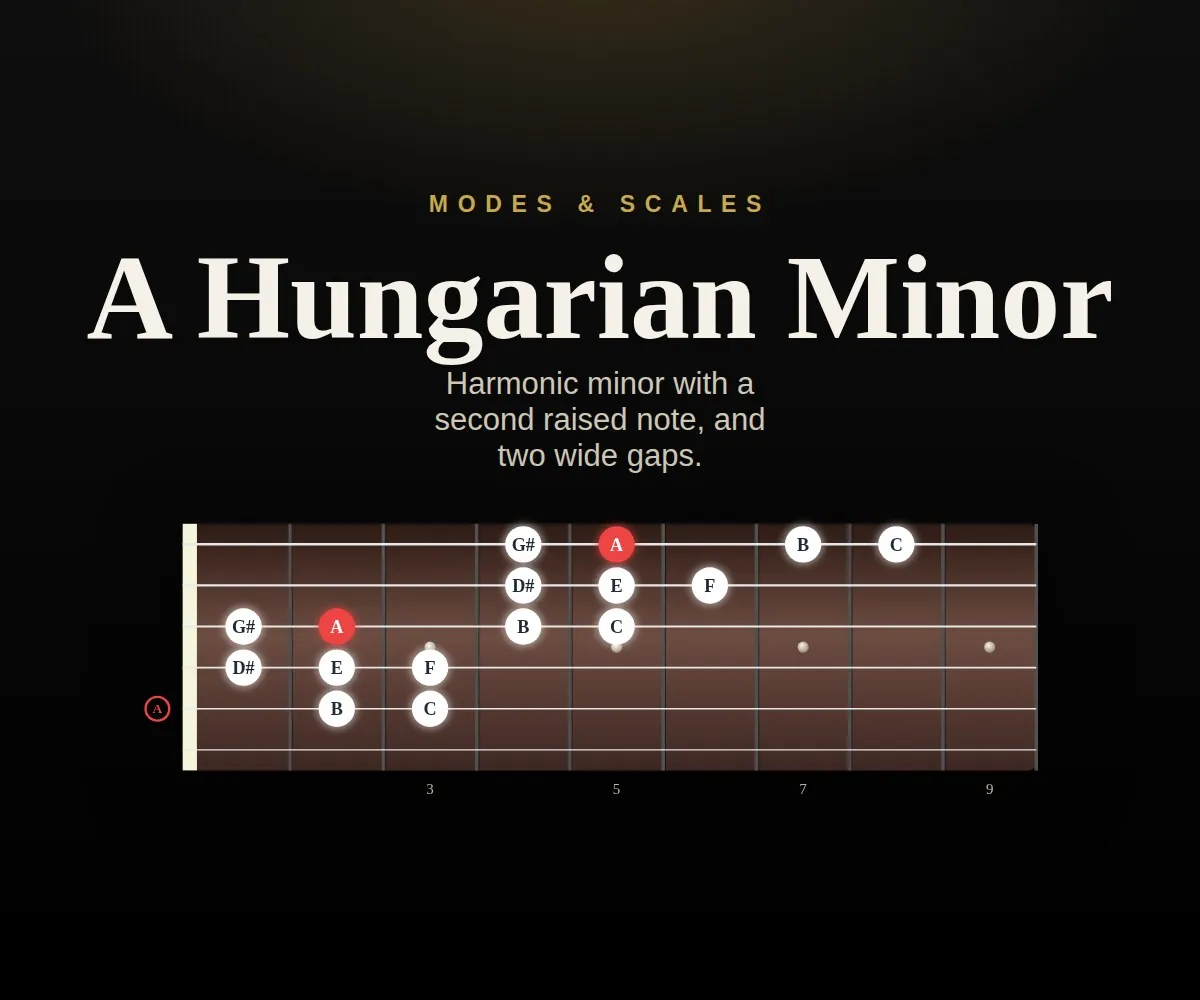
A Hungarian Minor
Harmonic minor with a second raised note, and two wide gaps.
Hungarian minor takes harmonic minor and raises the 4th as well. Where harmonic minor has one augmented second, this has two — which is why it sounds so much more distant than a normal minor scale.
 Play A Hungarian Minor on your phoneDownload free
Two raised notes
A Hungarian minor is A B C D# E F G#. Compared with A harmonic minor (A B C D E F G#), the 4th is raised from D to D#. The 7th was already raised. Two alterations, two wide gaps.
- It is harmonic minor with a #4.
- The #4 (D#) and the natural 7 (G#) are the raised notes.
- C to D# and F to G# are both augmented 2nds.
Why two gaps change everything
One augmented 2nd reads as a colour; two make the scale feel like it is built out of leaps instead of steps. Between them sits a symmetrical core (D# E F) that gives the scale its off-balance, unresolved quality.
- Two three-fret jumps in seven notes.
- Only three of the six steps are whole or half steps.
- The wide leaps are what make it sound non-Western.
Over a minor tonic, sparingly
It works over an Am or AmMaj7 chord — the raised 7th means it wants the major 7th in the chord. Use it as a colour over a static minor vamp rather than trying to run it through changes.
- Play it over Am or AmMaj7, not over Am7.
- A static minor pedal is the natural home for it.
- Neoclassical metal and Balkan folk both live here.
Raise the 4th of harmonic minor and you double the augmented seconds. That is the whole recipe for the sound.
 Prefer paper? All 408 scale charts in one bookThe Guitar Chord & Scale Encyclopedia · paperback and KindleSee the book →
MoreThanModes.com · Visual. Clear. Musical.