Transpose Any Song
Move a song to a key you can sing.
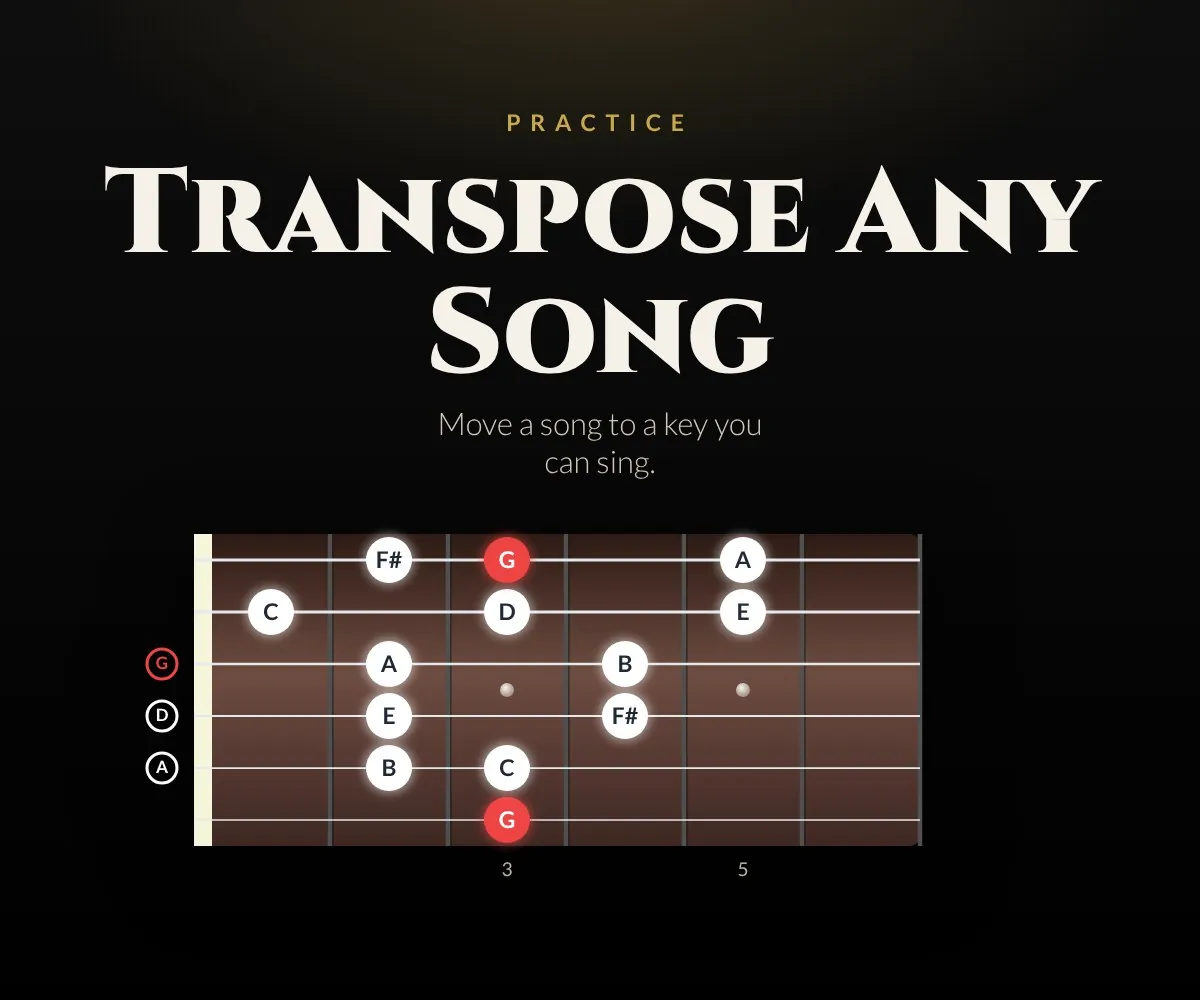
Transposing means moving every note and chord of a song by the same distance, so it fits your voice or another instrument. Turn the chords into numbers in their key, here G major, G A B C D E F#, and the song will play in any key.
 Practice it on your phoneDownload free
Chords are numbers in a key
In G major the chords G, C, D and Em are the I, IV, V and vi. Those numbers stay the same in every key; only the letters change. In A they become A, D, E and F#m; in C, C, F, G and Am. Learn the song as numbers and you know it in all twelve keys.
- G C D Em in G = I IV V vi.
- The same I IV V vi in A is A D E F#m.
- Major stays major, minor stays minor.
Count frets, or use a capo
Every fret is a half step. To move a song up a whole step, move every chord up two frets: G→A, C→D, D→E, Em→F#m. Or keep the shapes and put a capo on the 2nd fret: the G shapes now sound in A. Down works the same way, counting back.
- One fret = one half step, up or down.
- Capo 2 with G shapes sounds in A.
- Count on the low E string: G is 3, A is 5 — two frets.
Find the key that fits
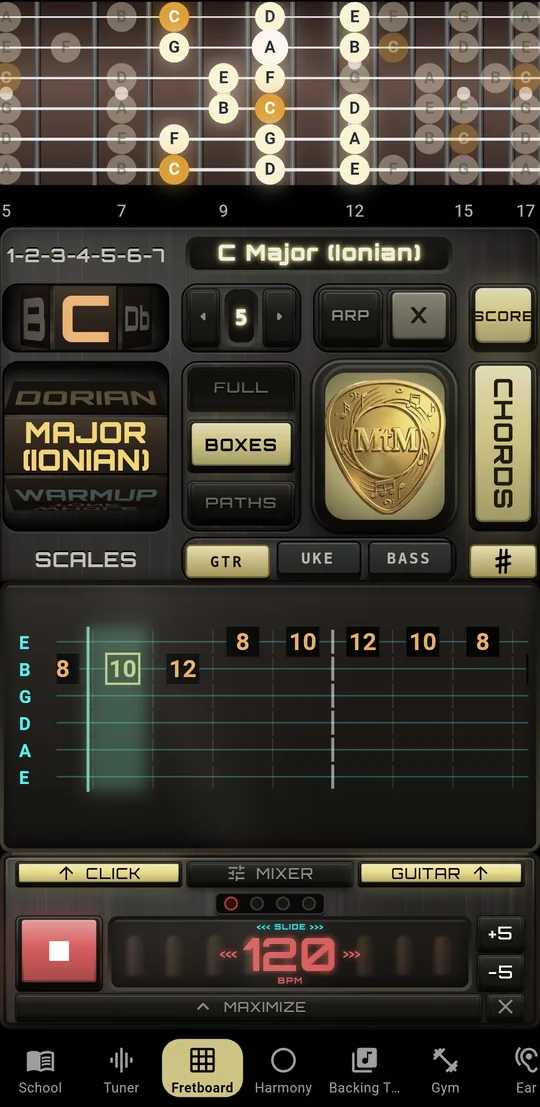
If the melody sits too high, try one or two half steps down; too low, go up. Sing the highest line of the chorus in each key and keep the one that does not strain. In More Than Modes you can open a Guitar Pro tab and transpose it on the fretboard, so you see the new frets and hear the new key right away.
- Test the chorus, not the verse — it is usually higher.
- Two or three half steps is often all it takes.
- Write the new chords above the old ones once you choose.
Turn the chords into numbers in their key and transposing is just counting: same numbers, new letters, same song.
 Prefer paper? All 408 scale charts in one bookThe Guitar Chord & Scale Encyclopedia · paperback and KindleSee the book →
MoreThanModes.com · Visual. Clear. Musical.