Intervals by Ear
Name the gap between two notes by ear.
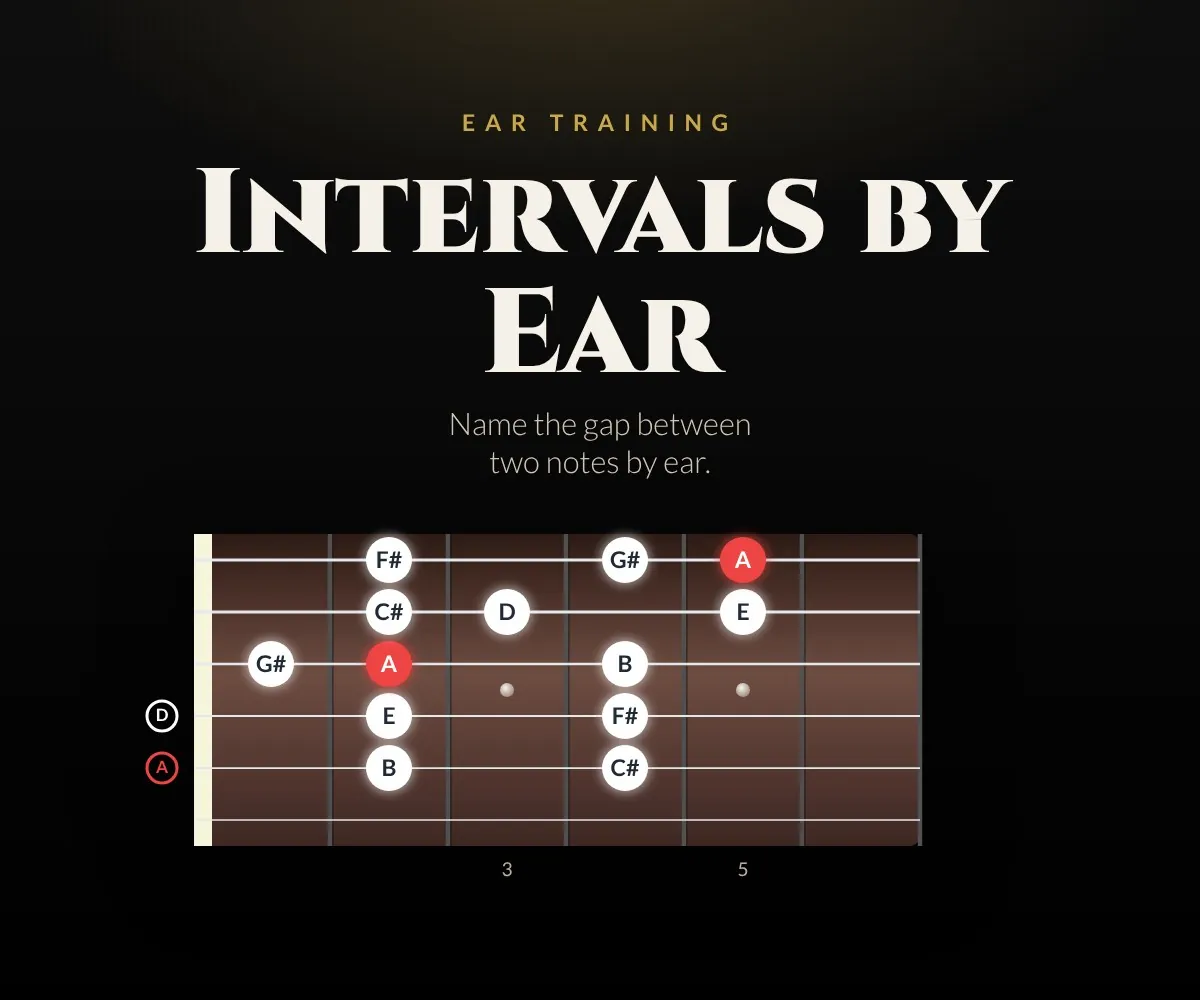
An interval is the distance between two notes, and recognizing them is the base of playing by ear. Tie each one to a song you know and practice them from the root of a scale, here A major, A B C# D E F# G#.
 Practice it on your phoneDownload free
Every interval has a song
The fastest way to remember an interval is the start of a melody you already know. A major 2nd is Frère Jacques; a major 3rd is When the Saints Go Marching In; a perfect 4th is Here Comes the Bride; a perfect 5th is Twinkle Twinkle Little Star; an octave is Somewhere Over the Rainbow.
- Major 2nd: Frère Jacques.
- Major 3rd: When the Saints. Perfect 4th: Here Comes the Bride.
- Perfect 5th: Twinkle Twinkle. Octave: Over the Rainbow.
Play them from the root
Put your finger on A at the 5th fret of the low E and play each note of A major against it: B is the 2nd, C# the 3rd, D the 4th, E the 5th. Sing the pair, then play it. Minor intervals are one fret smaller: C instead of C# is a minor 3rd — the first two notes of Smoke on the Water.
- Low E string, 5th fret: A, the root.
- Each scale note against the root is one interval.
- One fret less turns a major interval minor.
Five minutes a day
Ear training works in small, daily doses: five minutes, a few intervals, until naming them is instant. Start with the 3rd, 4th and 5th, then add the rest. In More Than Modes the ear trainer plays intervals for you to name, and the fretboard shows where each one sits on the neck.
- Learn three intervals well before adding more.
- Say the song, then the name, then play it.
- Five minutes a day beats an hour on Sunday.
Tie each interval to a song you know and play it from the root of a scale. A few minutes a day and your ear starts to name what it hears.
 Prefer paper? All 408 scale charts in one bookThe Guitar Chord & Scale Encyclopedia · paperback and KindleSee the book →
MoreThanModes.com · Visual. Clear. Musical.