Bass for Guitarists
Strings you know, an octave down, a new job.
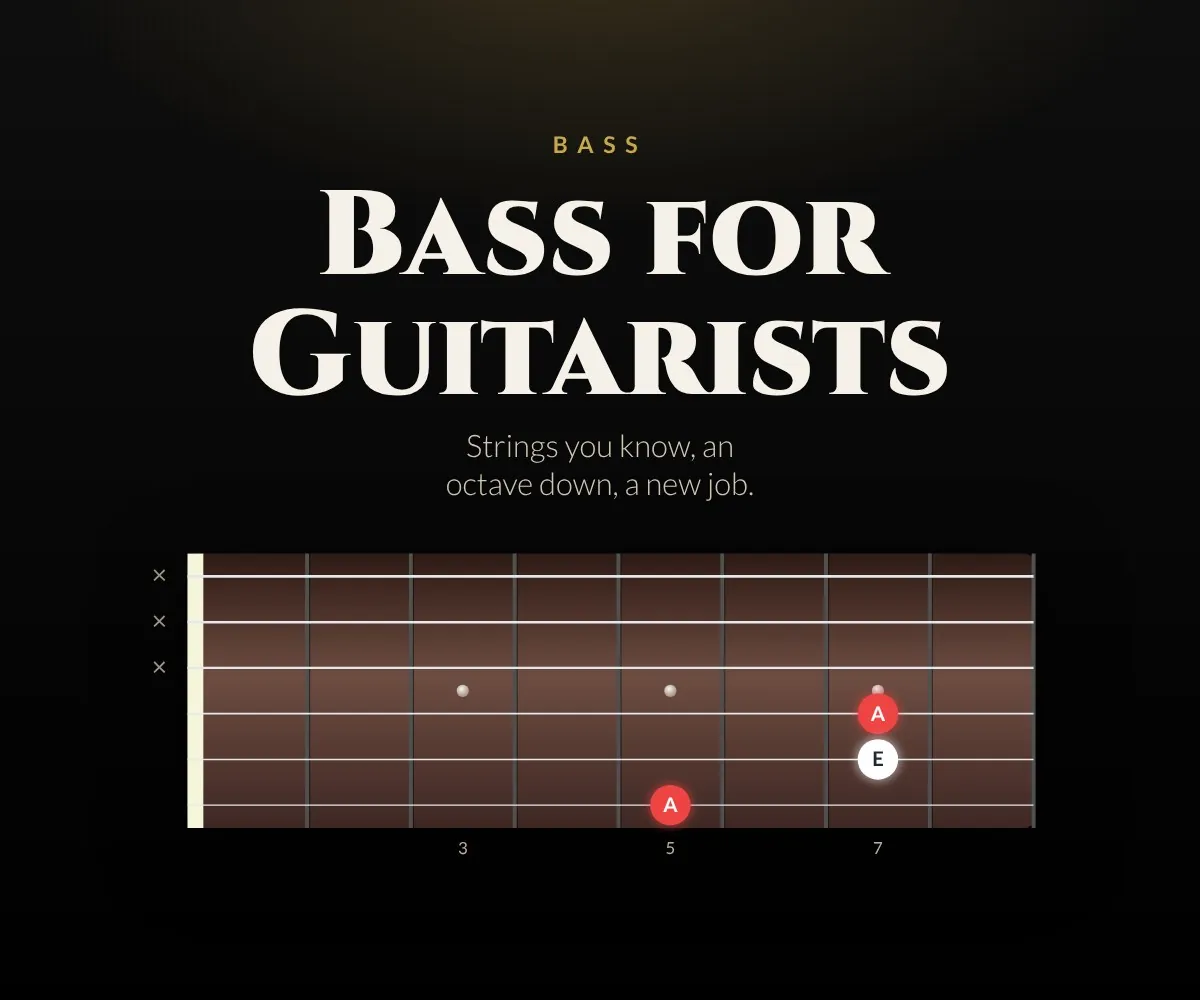
A bass is tuned E, A, D, G, like the four lowest strings of a guitar, an octave lower. The fingering is not the hard part; the job is. Most bass lines are built on the root, the fifth and the octave: the A5 shape, A E A.
 Practice it on your phoneDownload free
Same notes, different job
On guitar you fill space; on bass you hold the floor. The bass says which chord it is and where the beat is: play the root of each chord on beat 1 and the song already sounds right. Everything else is decoration.
- Bass E A D G = guitar E A D G, an octave down.
- Root on beat 1 of every chord.
- Lock in with the kick drum, not with the guitar.
Root, fifth, octave
The power chord you already know is the bass player’s main shape: root on the low E, fifth two frets up on the next string, octave two frets up on the one after. For A, that is the 5th fret, 7th, 7th — A, E, A. Walk between them in time and you have a bass line.
- A5 shape: low E 5, A 7, D 7 = A E A.
- Root–fifth–octave–fifth is a complete bass line.
- Move the same shape to any root on the low E string.
Walk into the next chord
To sound like a bass player, use the last beat of a bar to approach the next root from a half step below or above. From A to D, play A, E, A and then C# on beat 4 into the D. If a Guitar Pro file has a bass track, More Than Modes can show it on a bass fretboard and play it, so you can learn the real line.
- Approach notes: a half step below or above the next root.
- Fewer notes, more groove.
- Play along with the drums first, the band second.
On bass, the root on beat 1 is the whole job. Root, fifth and octave in the A5 shape you already know get you most of the way there.
 Prefer paper? All 2,592 chords in one bookThe Guitar Chord & Scale Encyclopedia · paperback and KindleSee the book →
MoreThanModes.com · Visual. Clear. Musical.