Loop It, Then Speed It Up
One hard bar, slow, then up to full speed.
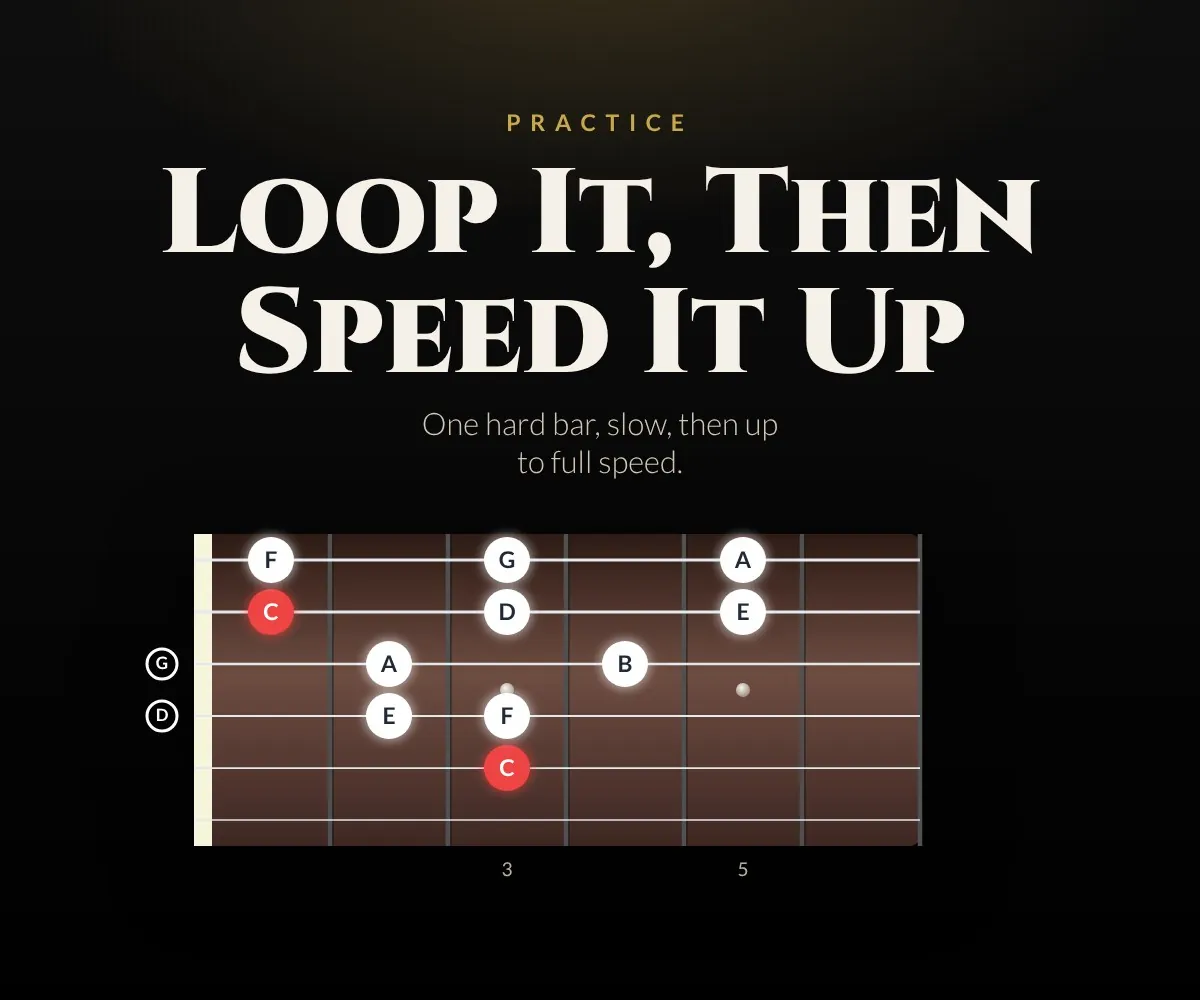
The fastest way to learn a hard passage is to stop playing the whole song. Cut out the two bars that break, loop them slowly until they are clean, then raise the tempo a little at a time. Here it is with a C major run, C D E F G A B.
 Practice it on your phoneDownload free
Practice the bar that breaks, not the song
Playing a song from the top again and again practices the easy parts most and the hard part least. Instead, find the one to four bars where it falls apart and loop only those, starting a note before and ending a note after so the joins get practiced too.
- Loop one to four bars, never the whole song.
- Start one note early and end one note late.
- If you cannot say which bar breaks, record yourself and listen.
Slow enough to be perfect
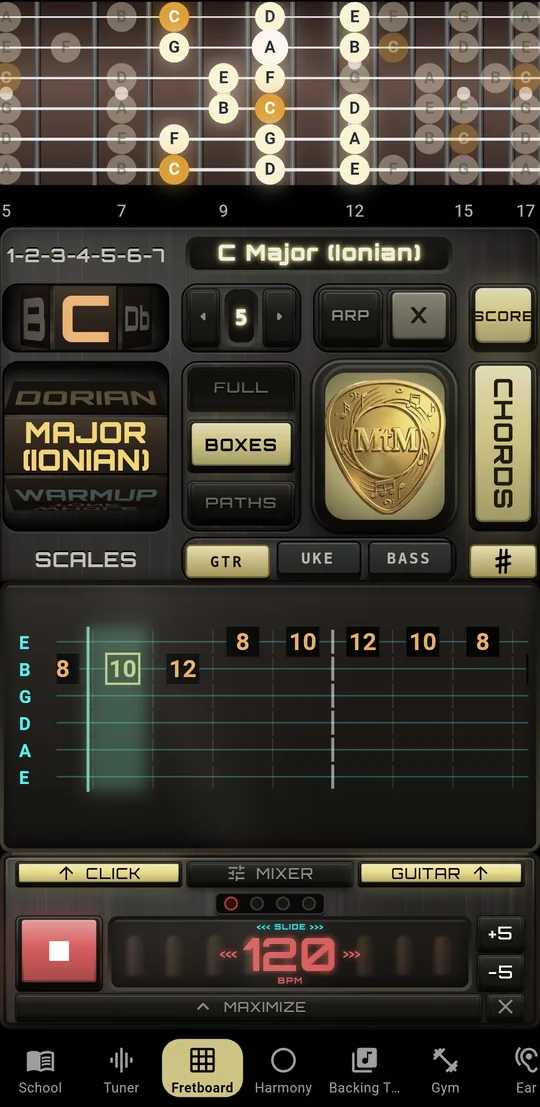
Set the metronome where you can play the loop five times in a row without a mistake — often half the real tempo. Then go up 4 or 5 bpm. When it breaks, drop back 10 and climb again. Try it with a three-notes-per-string C major run: the shifts between positions are exactly what falls apart at speed.
- Five clean repetitions before every tempo step.
- Steps of 4–5 bpm; when it breaks, go back 10.
- Relaxed hands at slow tempos are what make fast ones possible.
Stop when it is clean, not when you are tired
End the session on a clean run at the highest tempo you reached and write that number down; tomorrow, start a few bpm below it. In More Than Modes you can loop the bars of a Guitar Pro tab on the fretboard, set the tempo on the metronome, and raise it step by step.
- Write down today’s top tempo.
- Tomorrow, start 10 bpm below it.
- Ten focused minutes beat an hour of run-throughs.
Loop the bar that breaks, play it clean five times, add five bpm. Speed is just accuracy, repeated.
 Prefer paper? All 408 scale charts in one bookThe Guitar Chord & Scale Encyclopedia · paperback and KindleSee the book →
MoreThanModes.com · Visual. Clear. Musical.