C Whole Tone
Six notes, all the same distance apart, and no way home.
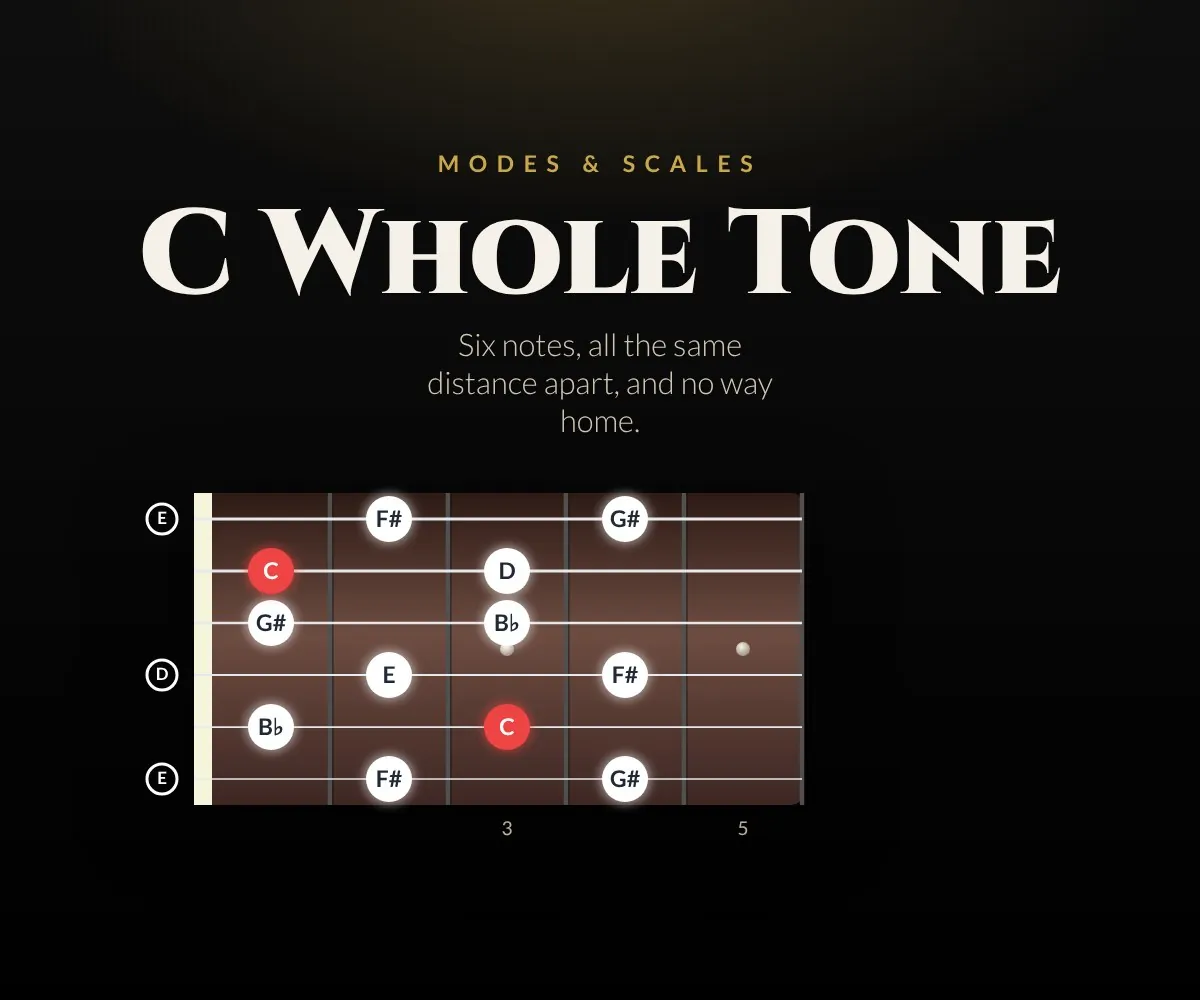
The C whole tone scale is C, D, E, F#, G# and B♭: six notes, each a whole step from the next. With no half steps there is no pull toward a home note, which is why it sounds like a dream sequence.
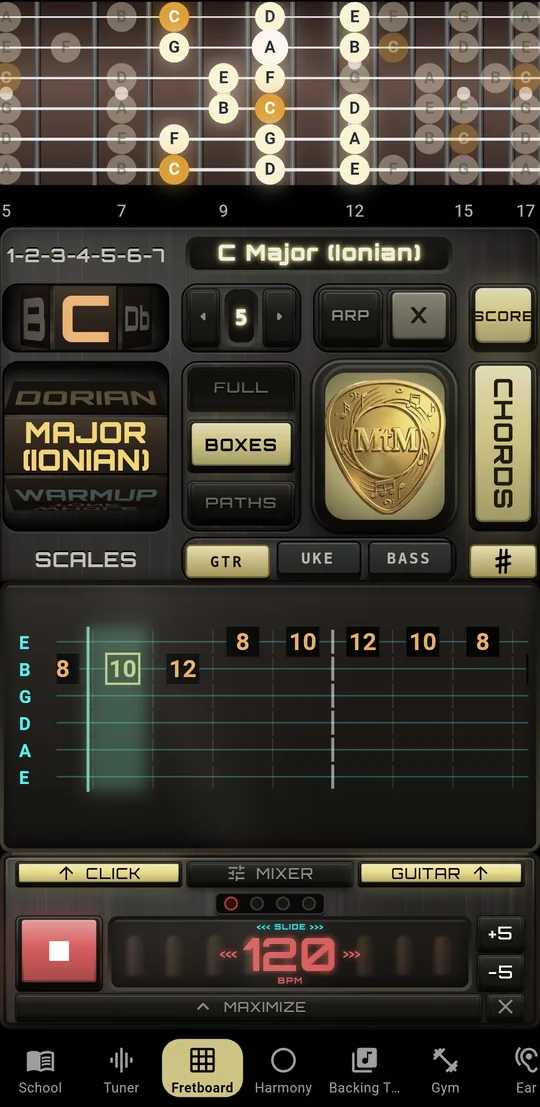 Play C Whole Tone on your phoneDownload free
Only whole steps
Every other scale mixes whole and half steps; this one uses only whole steps: 1 2 3 #4 #5 ♭7. Because every gap is the same, every note could be the root. There are only two whole tone scales in all of music — the one on C and the one on C#.
- C D E F# G# B♭ — six notes, not seven.
- Every step is two frets.
- C, D, E, F#, G# and B♭ whole tone are the same scale.
A pattern that repeats every two frets
Move the scale up two frets and you land on exactly the same notes. That makes it one of the easiest scales to finger: learn one position and slide it. It also means the shapes all look alike, so your ear, not the pattern, has to tell you where you are.
- Shift any shape by two frets: same notes.
- Learn one position, slide it up the neck.
- Listen for the floating sound, not a landing note.
Over augmented and 7#5 chords
The whole tone scale contains Caug (C E G#) and C7#5 (C E G# B♭), so it fits both note for note. Jazz uses it over a dominant 7#5; film music uses it for flashbacks and dreams. In More Than Modes you can see every position of the whole tone scale on the fretboard and try it over a backing track.
- Fits Caug, C7#5 and C9#5.
- Use it for a bar of tension, then resolve.
- Too long and the listener gets lost — that is the point.
Six notes, all a whole step apart: the whole tone scale has no home, and that floating feeling is exactly what it is for.
 Prefer paper? All 408 scale charts in one bookThe Guitar Chord & Scale Encyclopedia · paperback and KindleSee the book →
MoreThanModes.com · Visual. Clear. Musical.