D Major Pentatonic
Bright, open, and built for a slide.
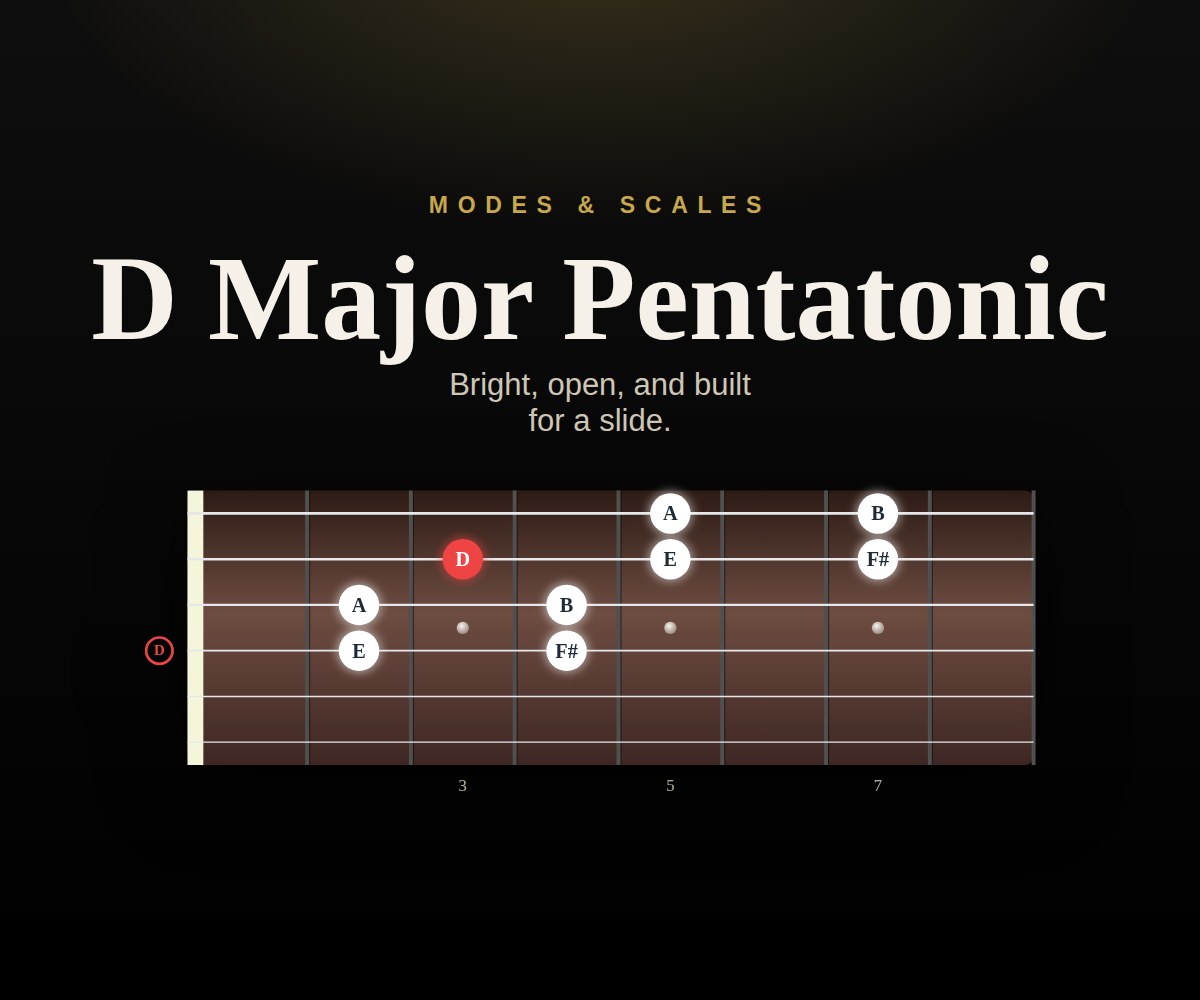
D major pentatonic is D, E, F#, A and B. Two sharps, the open D and A strings both in the scale, and a shape that sits right where the open chords are.
The major scale minus its two tensions
D major without the 4th (G) and the 7th (C#) leaves D E F# A B, formula 1 2 3 5 6. It is the same set of notes as B minor pentatonic, heard from a different home note.
- D E F# A B — two sharps.
- No half-steps, so no note can sound wrong.
- Shares its notes with B minor pentatonic.
The open-tuning key
D is the key acoustic guitarists retune towards — open D, DADGAD, drop D. In standard tuning the open D and A strings are already in the scale, so the shape at the 2nd fret blends straight into open-position chords.
- Open D and open A both belong to the scale.
- Box 1 at the 10th fret; the practical shape is at the 2nd.
- The key most slide and open-tuning playing lands in.
Where D major pentatonic lives
Over D, G and A it covers the whole progression. In folk, country and acoustic rock it is the scale for a melody that has to sit on top of strummed chords without fighting them.
- Fits D, Dmaj7 and a D–G–A progression.
- The go-to scale for acoustic and slide lead lines.
- Move to B minor pentatonic for the same notes, darker.
D major pentatonic is the acoustic guitar's bright key — two sharps, two open strings in the scale, and nothing that can clash.
MoreThanModes.com · Visual. Clear. Musical.