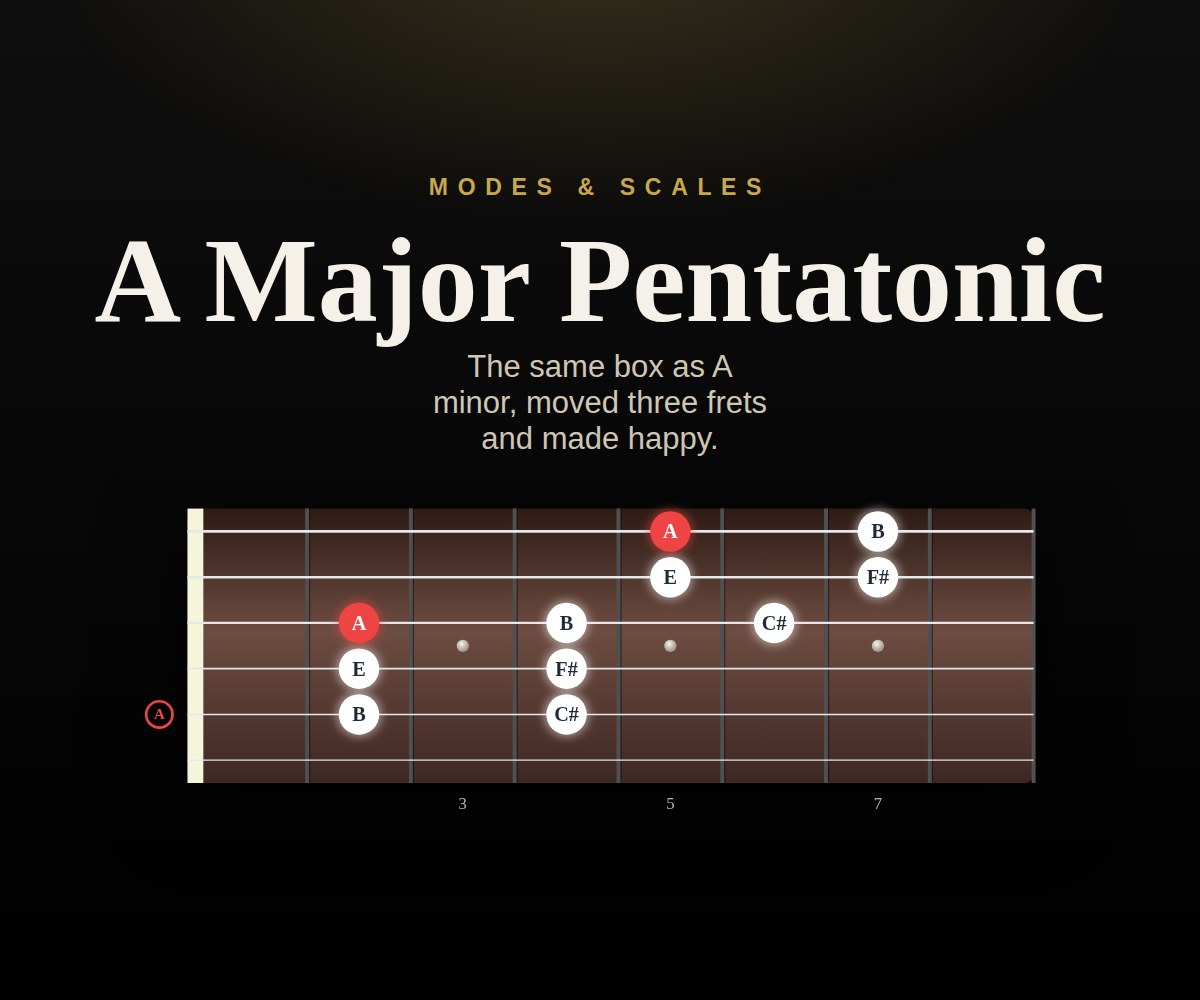
A Major Pentatonic
The same box as A minor, moved three frets and made happy.
A major pentatonic is A, B, C#, E and F#. It is the best demonstration of how pentatonics work on a guitar: the exact shape of A minor pentatonic, moved down three frets, sounding like its opposite.
One shape, two completely different moods
The formula is 1 2 3 5 6. Play the A minor pentatonic box at the 5th fret and it is dark; play the identical shape at the 2nd fret and it is A major pentatonic, bright and open. Nothing changed but where the root sits inside the shape.
- A B C# E F# — three sharps.
- Same five shapes as F# minor pentatonic, three frets lower.
- The root moves inside the box; the fingering does not change.
The country and blues-rock home key
A is where a guitar likes to be: the open A and open E strings are both in the scale, and the 2nd-fret box puts the whole shape within reach of open position. It is the key most country lead playing is written in.
- Box 1 at the 2nd fret, root on the low E string.
- Open A and open E both belong to the scale.
- The relative minor is F# minor pentatonic.
Where A major pentatonic lives
Over A, D and E it never puts a foot wrong. Over an A blues it is the sweet half of the vocabulary — most blues-rock playing moves between this and A minor pentatonic in the same solo, sometimes in the same bar.
- Fits A, Amaj7 and an A–D–E progression.
- Slide between it and A minor pentatonic for blues-rock phrasing.
- The default key for country lead guitar.
A major pentatonic is A minor pentatonic with the root moved — one shape, and the fastest way to understand what pentatonics really are.
MoreThanModes.com · Visual. Clear. Musical.