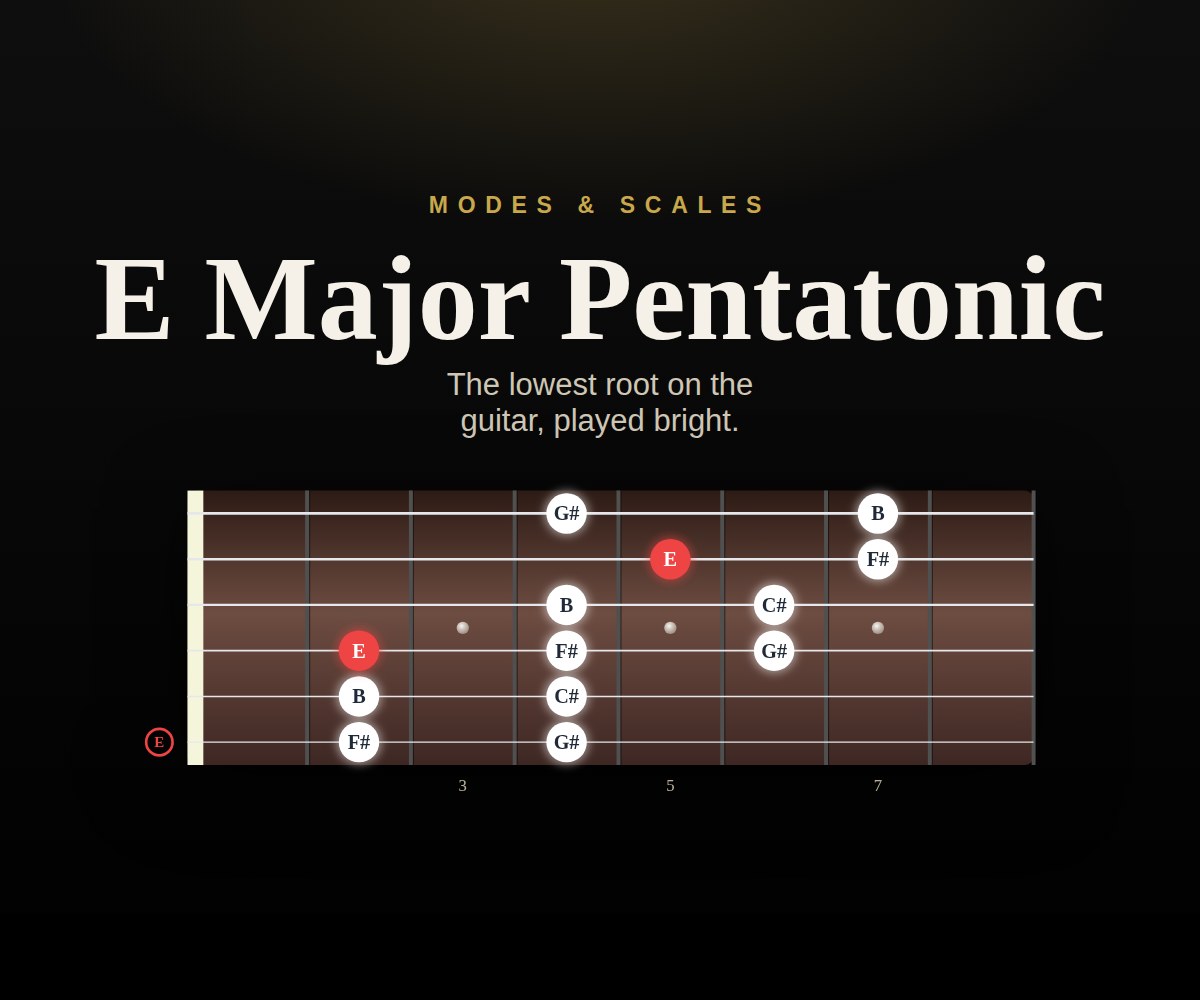
E Major Pentatonic
The lowest root on the guitar, played bright.
E major pentatonic is E, F#, G#, B and C#. E is the guitar’s lowest and most resonant root, and this is what that root sounds like without a trace of the blues.
Four sharps, five notes, no tension
E major with the 4th (A) and the 7th (D#) removed gives E F# G# B C#, formula 1 2 3 5 6. Four sharps on paper, and on the neck one of the easiest shapes there is, sitting at the open position.
- E F# G# B C# — four sharps.
- The formula is 1 2 3 5 6, same as every major pentatonic.
- Shares its notes with C# minor pentatonic.
Open position, lowest root, full sound
The low E and high E strings are both the root, and the open B is in the scale too. That gives the shape a weight nothing else has: phrases can start on an open low E and resolve two octaves up on the same note.
- Both E strings are the root; open B is the 5th.
- Box 1 at the 12th fret, with the open-position shape at the nut.
- The relative minor is C# minor pentatonic.
Where E major pentatonic lives
Over E, A and B. In country and rockabilly it is the standard lead vocabulary, and over an E blues it is the bright side — most players slide between this and E minor pentatonic, which is the first scale nearly everyone learns.
- Fits E, Emaj7 and an E–A–B progression.
- Pairs with E minor pentatonic for blues-rock phrasing.
- The key rockabilly and country lead playing live in.
E major pentatonic puts the guitar's deepest root under its brightest five notes — open position, two octaves, no tension anywhere.
MoreThanModes.com · Visual. Clear. Musical.