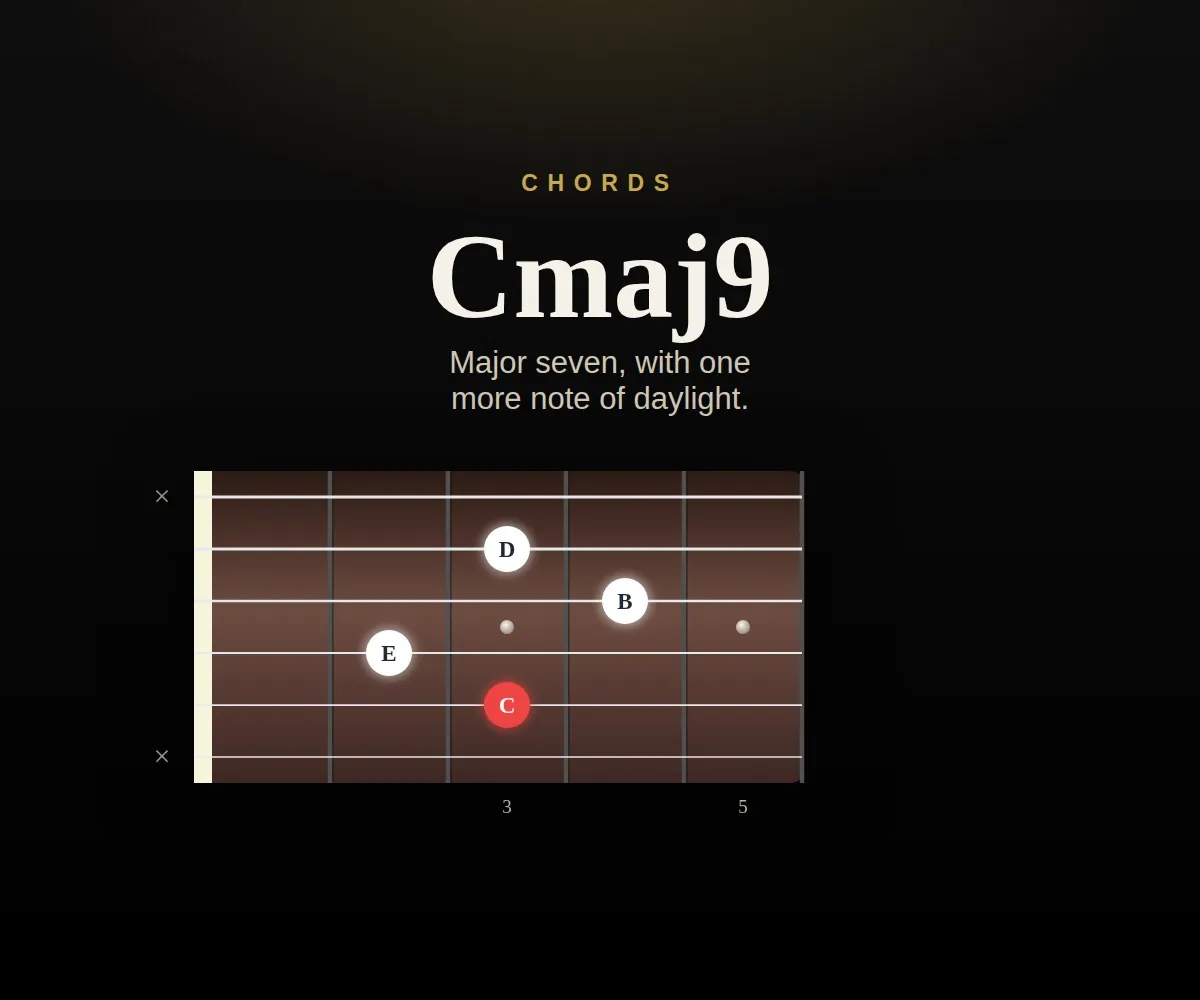
Cmaj9
Major seven, with one more note of daylight.
Cmaj9 is Cmaj7 with the 9th added on top. It keeps the warmth of the major 7th but opens it out — the sound of a soul ballad or a jazz intro rather than a folk song.
 Play Cmaj9 on your phoneDownload free
Five notes stacked in thirds
Cmaj9 is C E G B D — root, 3, 5, 7 and 9. The 9 (D) is just the 2nd degree an octave up. Stacked above the major 7th it adds brightness without adding tension.
- It is Cmaj7 plus the 9th (D).
- The 9 is the 2nd of the scale, moved up an octave.
- Major 7 and 9 together are the classic 'lush' major sound.
What to leave out
Five notes and six strings sounds easy until you try it in one hand. The usual move is to drop the 5th (G) — it carries no information here — and keep root, 3, 7, 9. That is the voicing you actually see on a chart.
- The 5th is the first note to drop.
- Root, 3, 7 and 9 is a complete-sounding maj9.
- In a band the bass covers the root, so you can drop that too.
Where it belongs
Use it as the I chord when a plain major sounds too blunt — the last chord of a ballad, the first chord of a bossa. Over a ii–V–I in C, land on Cmaj9 instead of C and the resolution keeps moving.
- Great as a final chord — resolved but not closed.
- Substitute it anywhere a Cmaj7 is written.
- Dm7–G7–Cmaj9 is the standard ii–V–I landing.
Adding the 9th to a major seventh does not add tension — it adds air. That is why every ballad ends on one.
 Prefer paper? All 2,592 chords in one bookThe Guitar Chord & Scale Encyclopedia · paperback and KindleSee the book →
MoreThanModes.com · Visual. Clear. Musical.