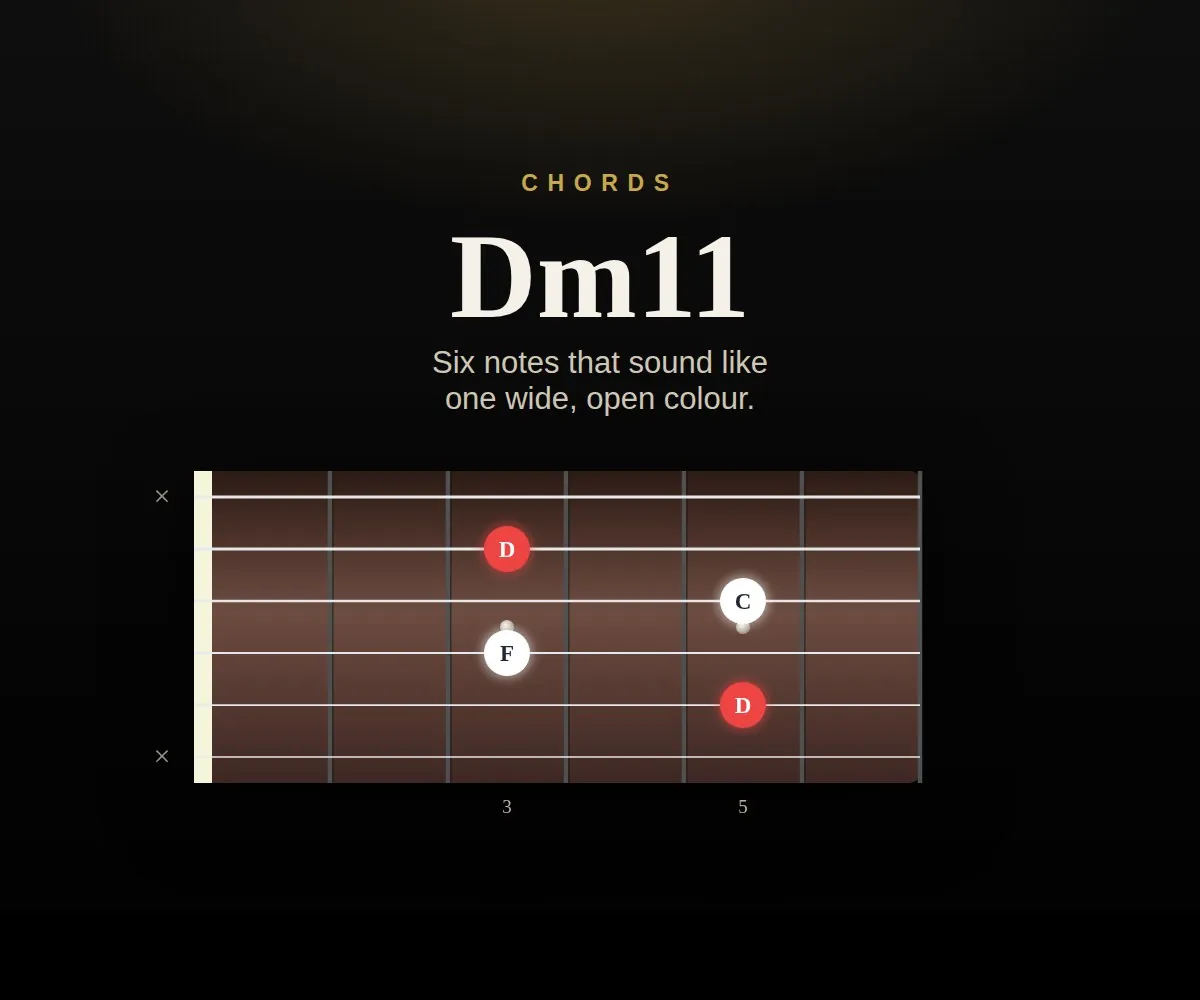
Dm11
Six notes that sound like one wide, open colour.
Dm11 stacks the 9th and the 11th on a minor 7th chord. Unlike its dominant equivalent, nothing in it clashes — which is why it sounds spacious rather than tense.
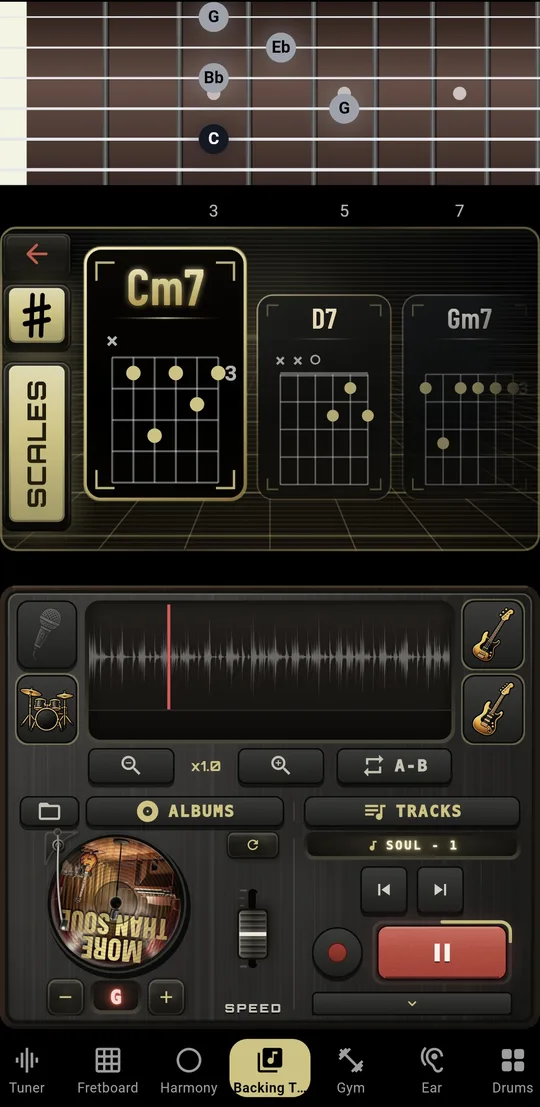 Play Dm11 on your phoneDownload free
A minor 7th, extended
Dm11 is D F A C E G — the whole of D Dorian stacked in thirds. The 11th (G) is a natural 4th, and over a minor 3rd it sits perfectly comfortably.
- It is Dm7 with the 9 (E) and 11 (G) added.
- Over a minor 3rd, the 11th does not clash.
- This is why m11 works where a dominant 11 does not.
The four notes that matter
Keep the root, the ♭7 (C), the 11 (G) and the ♭3 (F) — or, more often, drop the ♭3 entirely and play D G C F: a stack of fourths. That quartal voicing is the modern sound of this chord.
- Drop the 5th first, then the 9th.
- D–G–C–F is a stack of fourths and a real Dm11.
- Quartal voicings are what make it sound modern rather than jazzy.
As a ii chord, or as a place to sit
It is the ii chord in C major: Dm11 – G7 – Cmaj7. It also works as a static vamp chord, because with no tension in it there is nothing that needs resolving.
- Use it as ii in a ii–V–I in C.
- It vamps well — nothing in it demands to move.
- D Dorian is the scale, note for note.
The 11th is a problem over a major 3rd and a gift over a minor one. Dm11 is the whole of Dorian in a single grip.
 Prefer paper? All 2,592 chords in one bookThe Guitar Chord & Scale Encyclopedia · paperback and KindleSee the book →
MoreThanModes.com · Visual. Clear. Musical.