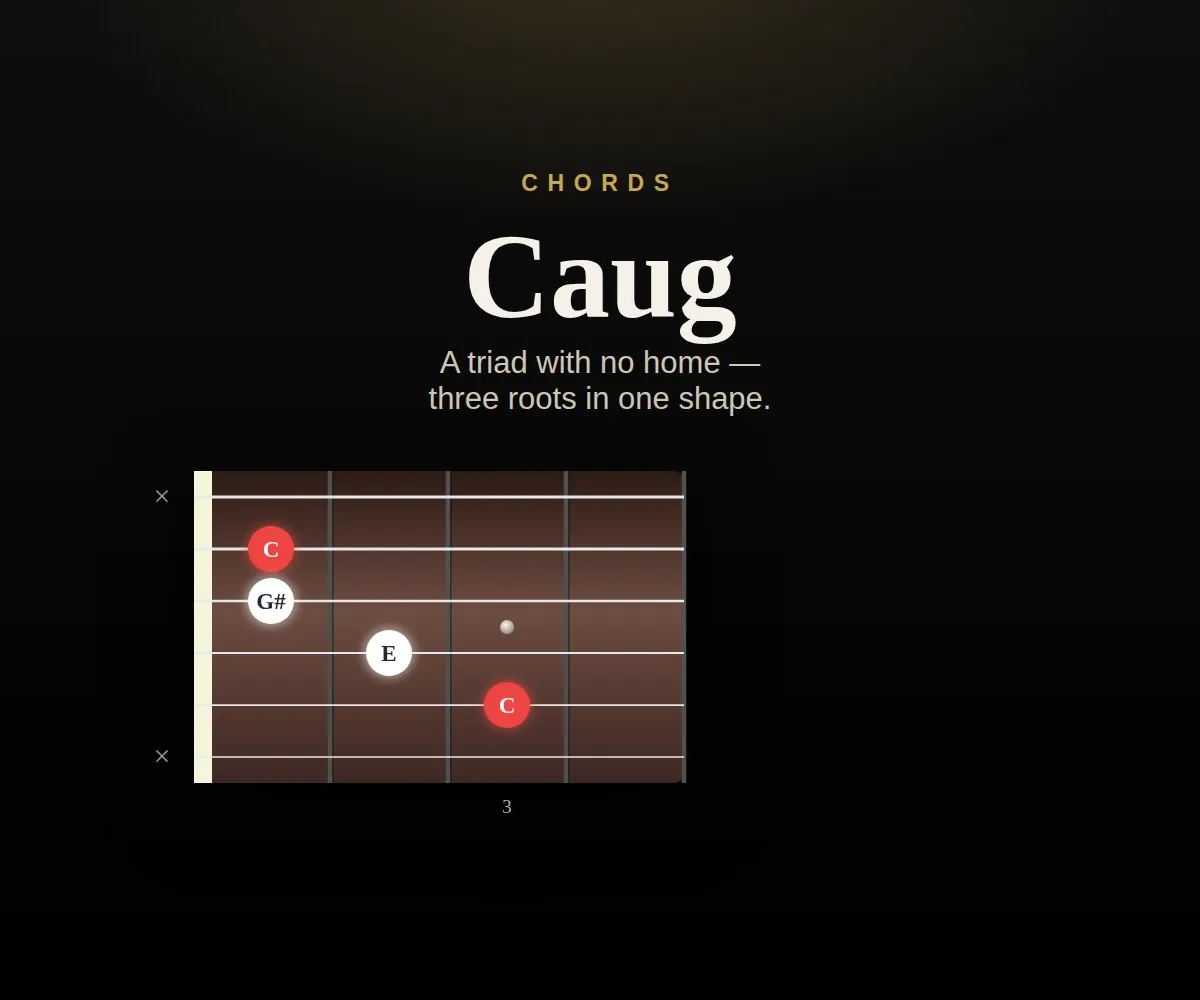
Caug
A triad with no home — three roots in one shape.
An augmented triad divides the octave into three equal parts. Because every interval in it is identical, it has no root at all until something around it decides which note that is.
 Play Caug on your phoneDownload free
Two major thirds stacked
Caug is C E G# — a major triad with the 5th raised. C to E is a major 3rd, and E to G# is a major 3rd. The chord is perfectly symmetrical.
- The #5 (G#) replaces the natural 5.
- Both intervals inside it are major 3rds.
- Also written C+ or C(#5).
Caug, Eaug and G#aug are the same chord
Because it is symmetrical, the same three notes spell an augmented triad on any of them. One shape, moved up four frets, gives you the identical chord — there are only four augmented triads in all of music.
- Caug = Eaug = G#aug — the same three notes.
- Only four distinct augmented triads exist.
- Slide any shape four frets and nothing changes.
As a hinge between chords
Its real job is transitional: C → Caug → Am or C → Caug → F. The G# is passing between the G of the C chord and the A above it. One note moves; the chord underneath does the rest.
- C–Caug–F walks G up to A.
- Use it as the V chord (Gaug → C) for a stronger push.
- The whole-tone scale is what fits over it.
An augmented triad has no root of its own. Treat it as a moving note between two real chords and it stops being strange.
 Prefer paper? All 2,592 chords in one bookThe Guitar Chord & Scale Encyclopedia · paperback and KindleSee the book →
MoreThanModes.com · Visual. Clear. Musical.