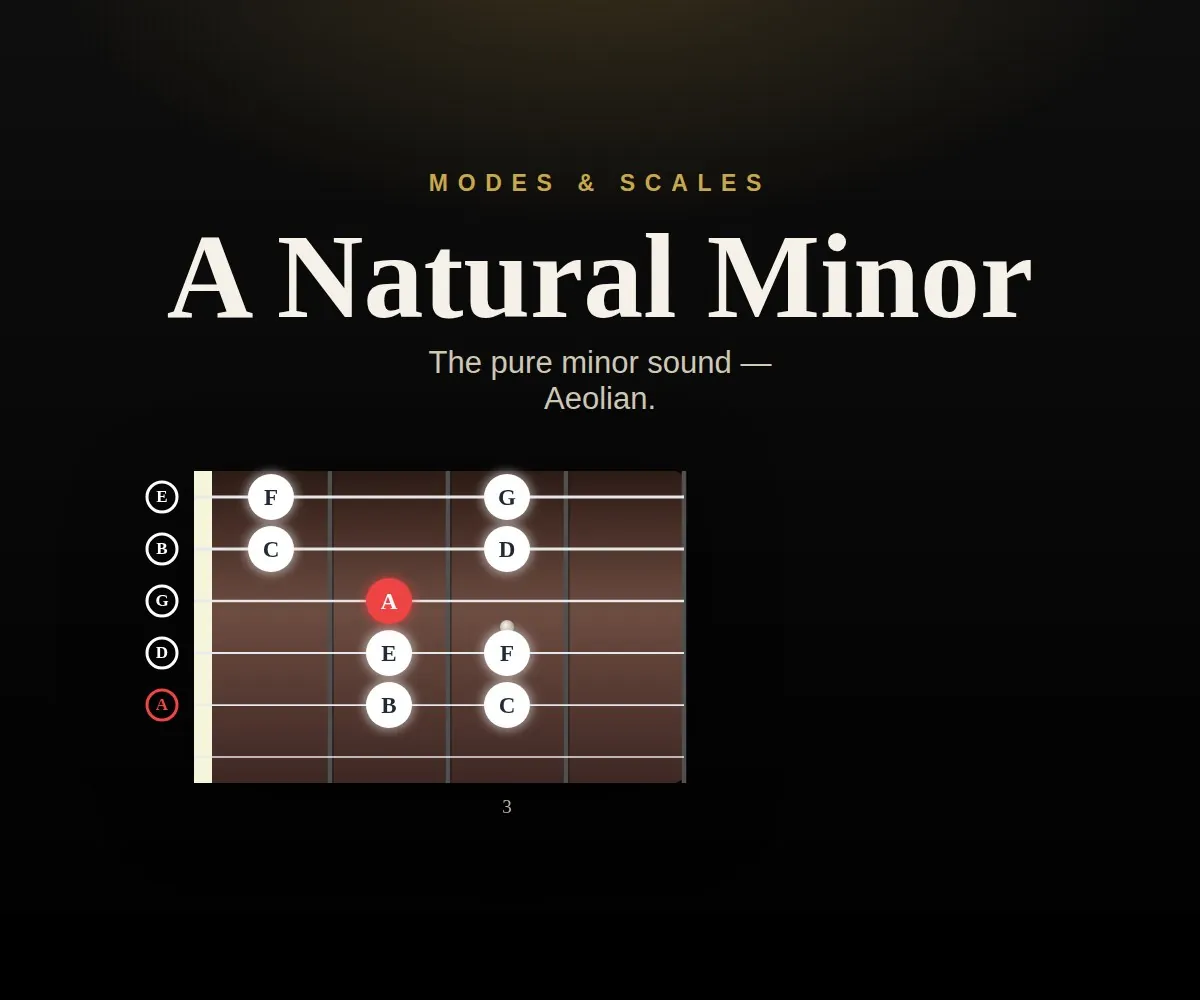
A Natural Minor
The pure minor sound — Aeolian.
Aeolian is the natural minor scale: the default sad sound, and the relative minor of C major. Every guitarist's first minor scale.
 Play A Natural Minor on your phoneDownload free
The pure minor scale
A Aeolian is A B C D E F G — no sharps, no flats. It has the ♭3 (C), ♭6 (F) and ♭7 (G) that define natural minor.
- The ♭3 (C) makes it minor.
- The ♭6 (F) and ♭7 (G) give it its full darkness.
- It is the relative minor of C major — same notes, new home.
The ♭6 that darkens it
Compared to Dorian, Aeolian's ♭6 (F) is what makes it fully dark. That note is the difference between a hopeful minor and a truly sad one.
- The ♭6 (F) is the darkest tone in the scale.
- Resolve down from F to E for a classic minor sigh.
- It contrasts directly with Dorian's natural 6.
Where natural minor lives
Aeolian works over a minor key that stays put — a i–♭VI–♭VII progression (Am–F–G) is pure natural minor, the sound of countless rock and pop songs.
- Am–F–G (♭i–♭VI–♭VII) is the natural-minor progression.
- Use it when the minor key doesn't borrow a raised 7th.
- A Aeolian = C major from A.
All chords in the key of A minor — hear them on the circle →
Natural minor is the baseline every other minor sound is measured against — learn it first, then hear how the modes bend it.
 Prefer paper? All 408 scale charts in one bookThe Guitar Chord & Scale Encyclopedia · paperback and KindleSee the book →
MoreThanModes.com · Visual. Clear. Musical.