C Lydian
The major scale with one note raised into daylight.
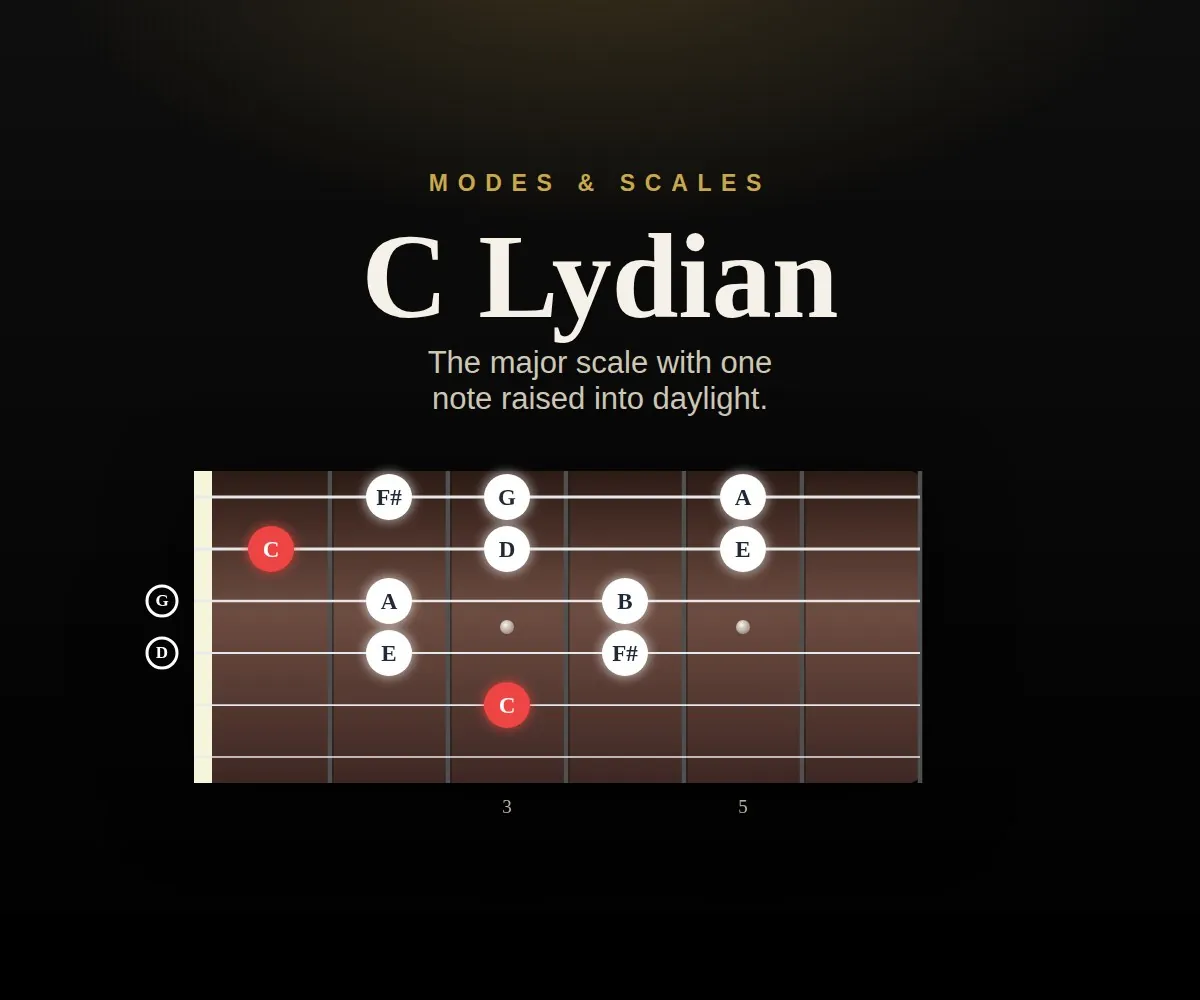
C Lydian is C major with the 4th raised. One note, and the scale stops sounding like a resolved major key and starts sounding like a film score.
 Play C Lydian on your phoneDownload free
Major with a #4
C Lydian is C D E F# G A B. Everything is the same as C major except the F, which is raised to F#. That #4 is the only difference and the entire character.
- The major 3 (E) keeps it bright.
- The #4 (F#) is what makes it Lydian.
- Lower it to F and you are back in plain C major.
Why the natural 4 is the problem
In C major, F is a half-step above E and sits awkwardly against the major 3rd — which is why it is the note players are told to pass through quickly. Raise it and that clash disappears. Lydian is the major scale with its one weak note fixed.
- The natural 4 clashes with the major 3rd; the #4 does not.
- That is why Lydian sounds like major, only more so.
- The #4 floats — it has no urge to resolve.
Finding a real Lydian context
You need a chord that supports the F#. A Cmaj7#11 does it, and so does a simple C to D vamp — that D major chord holds the F# and turns the whole passage Lydian.
- C to D (I to II) is the Lydian progression.
- Over Cmaj7#11 the scale fits exactly.
- Over a plain C major chord in a C major song, the F# will sound wrong — the context has to carry it.
Lydian is not an exotic scale. It is the major scale with its one uncomfortable note raised out of the way.
 Prefer paper? All 408 scale charts in one bookThe Guitar Chord & Scale Encyclopedia · paperback and KindleSee the book →
MoreThanModes.com · Visual. Clear. Musical.