A7sus4
A dominant chord that refuses to say whether it is happy.
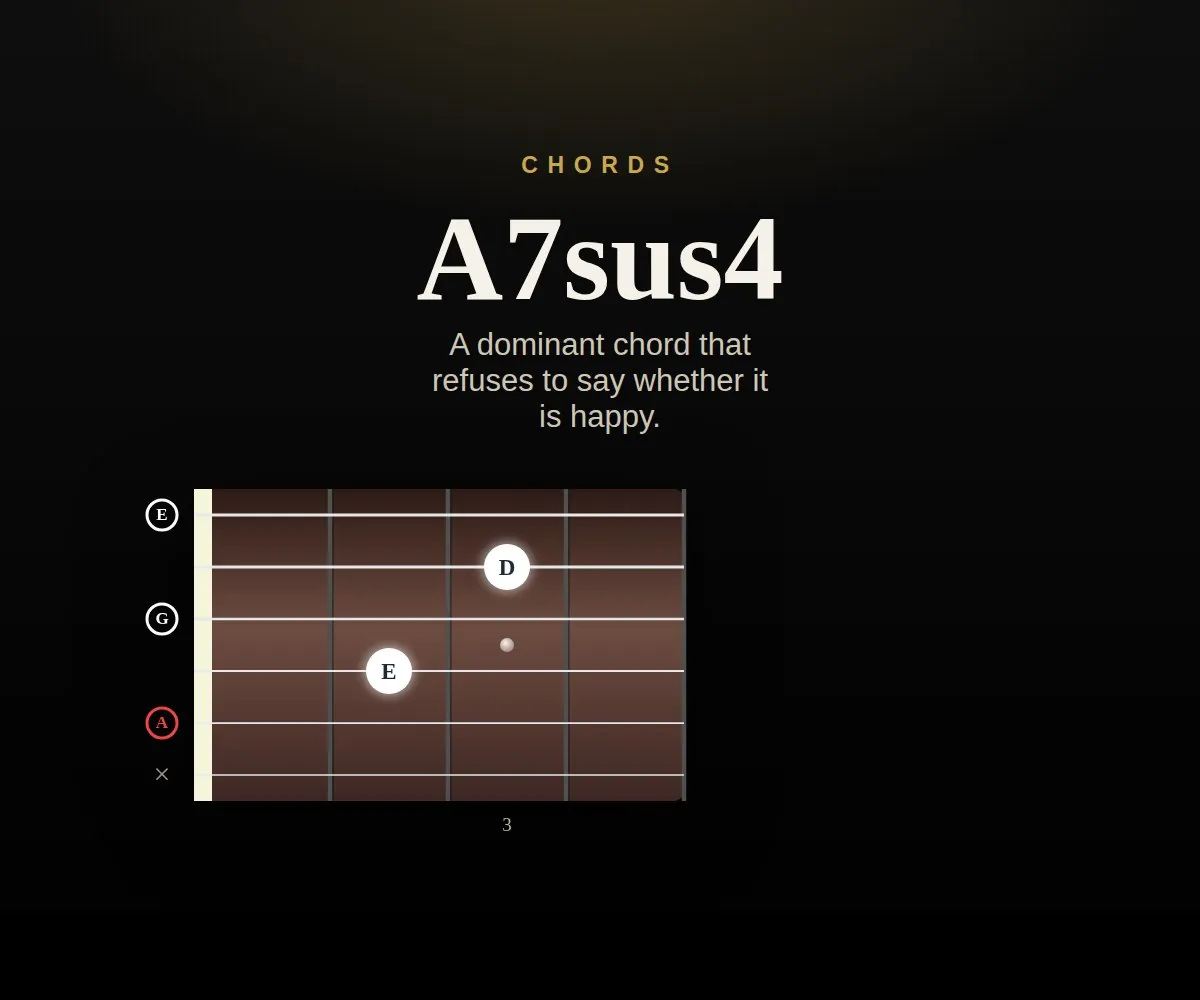
A7sus4 takes a dominant 7th and replaces the 3rd with the 4th. It keeps all the forward motion of a dominant chord and loses all of its brightness.
 Play A7sus4 on your phoneDownload free
The 3rd swapped for the 4th
A7sus4 is A D E G. A normal A7 would have C# as its 3rd; here the 4th (D) takes its place. Without a 3rd it is neither major nor minor, but the ♭7 (G) keeps it restless.
- The 4 (D) replaces the 3rd — that is what 'sus' means.
- The ♭7 (G) keeps it functioning as a dominant.
- No 3rd means no major or minor colour.
Suspend, then resolve
The oldest use is to play A7sus4 and then A7, letting the D fall to C#. That half-step is the whole point of a suspension: you set up a note that has somewhere to go, then let it go there.
- A7sus4 → A7 is the textbook resolution.
- The D drops a half-step to C#.
- Delay the resolution and the tension does the work for you.
Or never resolve it at all
Modern playing often just stays on it. A 7sus4 chord is stable enough to vamp over for bars at a time — the sound of countless intros where the song has not decided its key yet.
- Vamp on it to hold a section open.
- It is a standard intro chord — motion without commitment.
- Over it, A Mixolydian works with the 3rd avoided.
Take the 3rd out of a dominant chord and you keep the momentum but lose the mood — which is exactly why intros are full of them.
 Prefer paper? All 2,592 chords in one bookThe Guitar Chord & Scale Encyclopedia · paperback and KindleSee the book →
MoreThanModes.com · Visual. Clear. Musical.