A7♭9
The dominant that pulls toward minor.
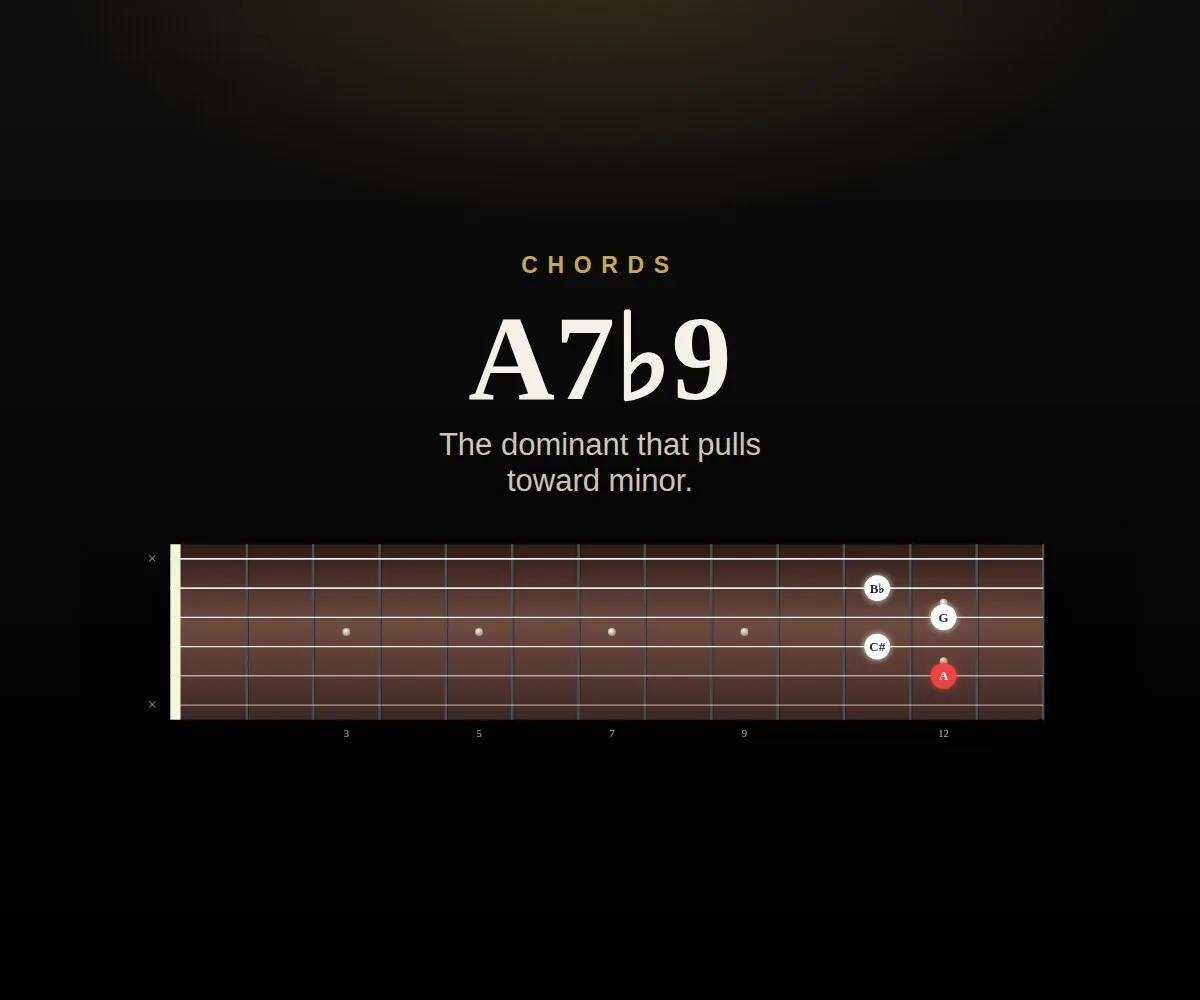
A7♭9 is a dominant 7th with a flattened 9th on top. It is the standard V chord when the song is heading to a minor tonic — sharper and more urgent than a plain A7.
 Play A7♭9 on your phoneDownload free
A half-step above the root
A7♭9 is A C# E G B♭. The ♭9 (B♭) sits one half-step above the root. That is an unusually harsh distance to have inside a chord, and it is exactly what makes it want to move.
- The ♭9 (B♭) is a half-step above the root.
- Everything else is a normal A7.
- The dissonance is the function — it forces a resolution.
There is a diminished 7th inside it
Drop the root and what is left — C# E G B♭ — is a diminished 7th chord. Guitarists exploit this constantly: play any dim7 shape a half-step above the root of the dominant and you have a 7♭9.
- C#dim7 over an A bass = A7♭9.
- Any dim7 grip works, since dim7 repeats every three frets.
- It is the fastest way to find the chord on the neck.
Going to minor
Use it as the V of a minor key: A7♭9 → Dm. The ♭9 already belongs to D minor, so the chord is pointing at the destination before it arrives. Over it, play A Phrygian dominant or the altered scale.
- A7♭9 → Dm is the minor ii–V–i resolution.
- The ♭9 (B♭) is already a note of D minor.
- Phrygian dominant and the altered scale both fit.
A flat 9th is a half-step of pure friction inside a chord — and it is the shortest route from a dominant to a minor resolution.
 Prefer paper? All 2,592 chords in one bookThe Guitar Chord & Scale Encyclopedia · paperback and KindleSee the book →
MoreThanModes.com · Visual. Clear. Musical.