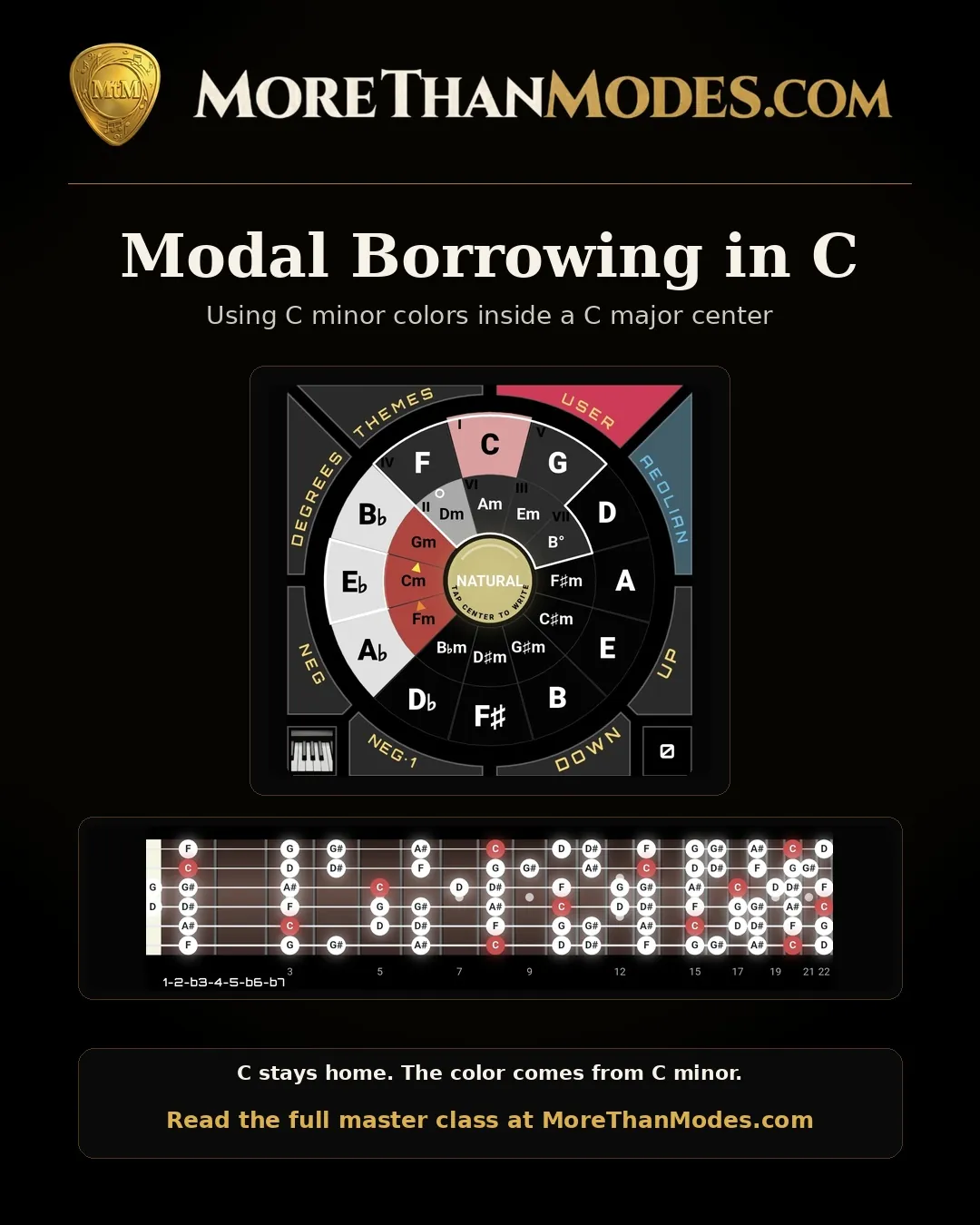
Modal Borrowing in C
Using C minor colors inside a C major center
More blog lessons
Modal borrowing is not just a way to add unusual chords. It is a controlled change of musical viewpoint: C remains the center, but the surrounding color can temporarily come from C minor. Once that shift is clear, Cm, Fm, Gm, Eb, Ab, and Bb stop feeling random and become deliberate harmonic colors.
 Play it on your phoneDownload free
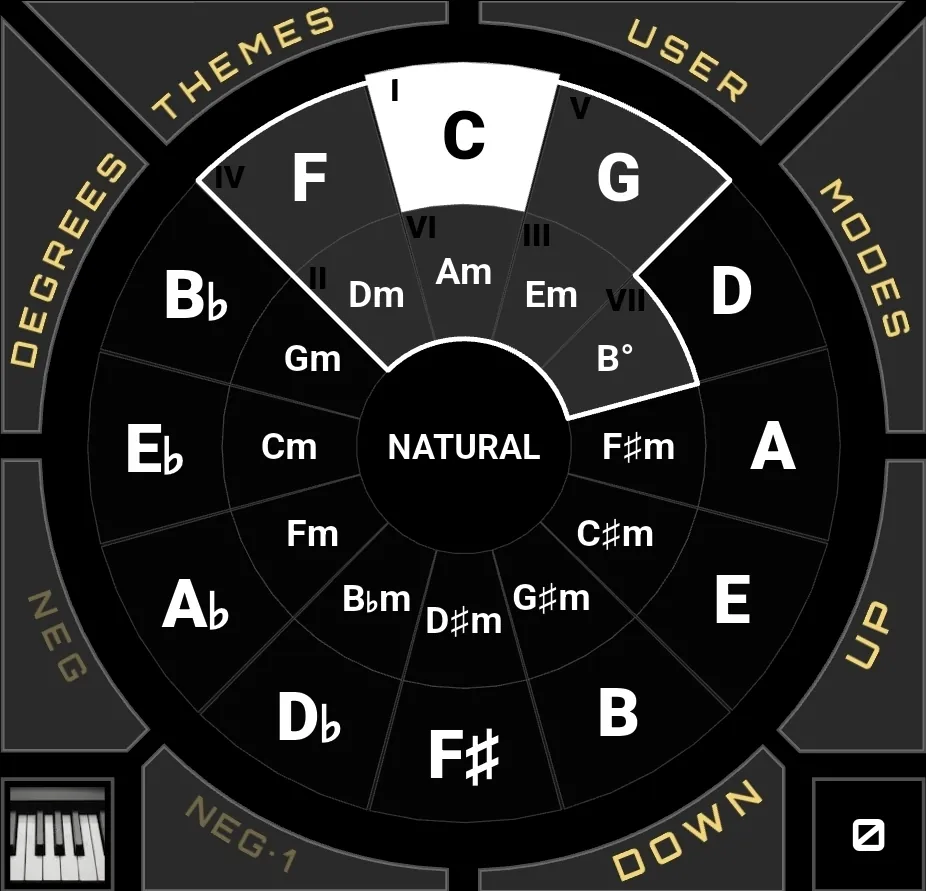
C major as the home system
The C major circle gives the stable reference point: C is I, and the natural diatonic field is C, Dm, Em, F, G, Am, and B diminished. This is the bright default system where E natural, A natural, and B natural define the major sound.
- C major gives the listener a clear sense of home through I, IV, V, and vi.
- The notes E, A, and B are the degrees that keep the harmony inside the major color.
C minor as the borrowed color source
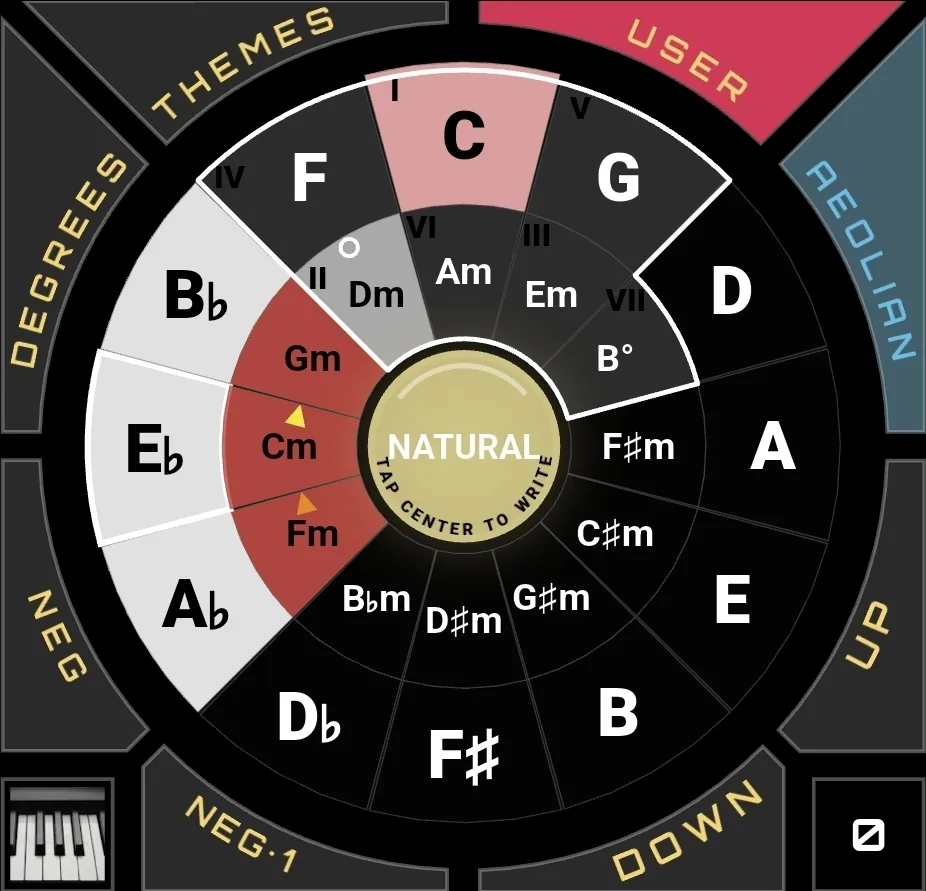
The Aeolian circle keeps C at the center but changes the color source to C minor. The highlighted minor chords show practical borrowed colors, while the outer relationship to Eb explains where the note collection comes from.
- C minor is parallel to C major because both systems are centered on C.
- C minor is also relative to Eb major because both share the same notes, but the musical center decides the function.
The major fretboard mindset
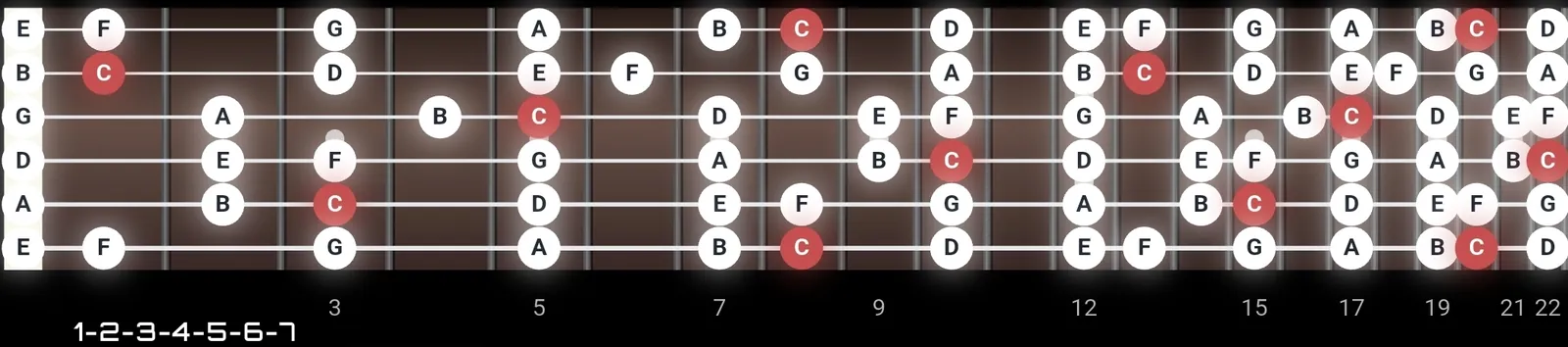
The C major fretboard map shows the 1-2-3-4-5-6-7 framework. When the harmony is diatonic to C major, this map reinforces clarity, resolution, and an inside sound.
- E natural is the major third that confirms C as a major tonic.
- B natural behaves like a leading tone and creates a strong pull back to C.
The minor fretboard mindset
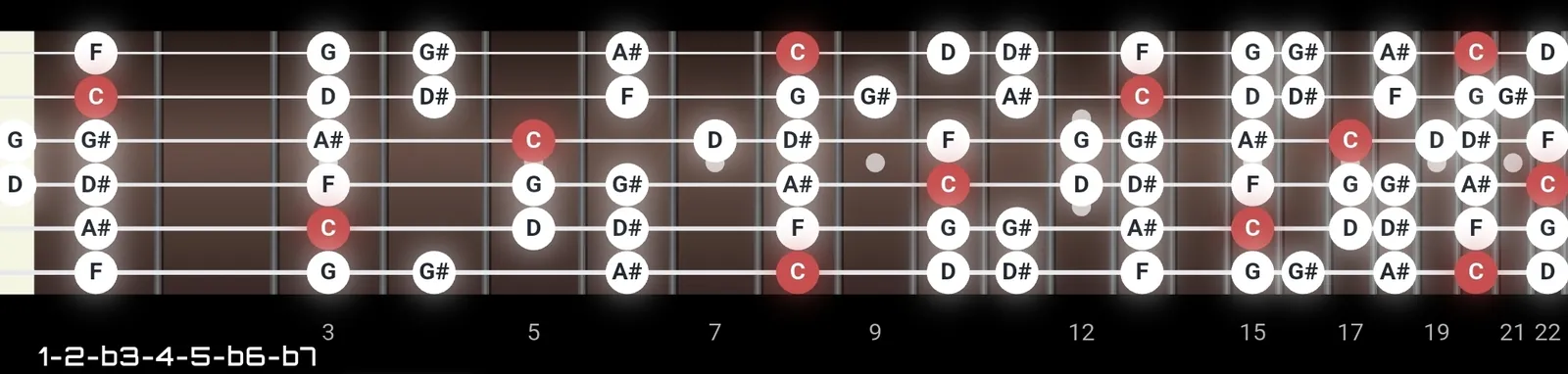
The C natural minor map changes the thinking to 1-2-b3-4-5-b6-b7. The root C stays fixed, but Eb, Ab, and Bb create a darker vocabulary that explains the borrowed chords.
- Eb changes the identity of the tonic color from major to minor.
- Ab and Bb create the bVI and bVII sounds that make modal borrowing feel broader than a single chord substitution.
Cm, Fm, and Gm as borrowed minor examples
The three minor chords highlighted in the Aeolian view show different levels of modal color. Cm changes the tonic quality, Fm creates the classic minor iv color, and Gm removes the leading-tone pressure of G major.
- C to Fm to C creates emotional contrast because A natural drops to Ab.
- Gm softens the dominant area because B natural becomes Bb.
Progressions that use the borrowed system
A strong borrowed progression does not need to use every chord from C minor. One or two borrowed sonorities are enough if they are placed where the ear can hear the color shift and the return to C.
- C - F - Fm - C uses the minor iv as a clear emotional turn.
- C - Ab - Bb - C and C - Eb - F - C use bVI, bVII, and bIII as modal colors around the same center.